If you run a small vending route, the best insurance companies for a small vending machine business are generally Nationwide, The Hartford, Hiscox, Next Insurance, and Thimble. I have carried policies from four of these five across machines placed in laundromats, auto shops, and break rooms. The right pick depends less on brand name and more on whether the carrier understands unattended equipment, spoilage, and liability at third-party locations. Nationwide tends to win for mixed routes with vehicles and warehouse storage. Hiscox and Next fit solo operators who need fast certificates. The Hartford handles larger routes with employees. Thimble works for part-time operators with a handful of machines. Below is how they actually perform when you file a claim.
How I Rank Vending Machine Insurance (Not Just Price)
Most quote engines treat a vending route like a retail store. That is a problem. Your machines sit on someone else's property, run unattended, hold cash, and dispense food. A general liability policy written for a storefront often excludes the two things that actually hurt: product spoilage after a compressor failure and damage to a host's floor from a leaking machine.
After twelve years and roughly 140 placements, I weight four things: whether the policy covers off-premises equipment, whether spoilage is included or requires an endorsement, how fast the carrier issues a certificate of insurance (COI) for a new location, and how claims are handled when the loss is under $5,000. Small claims decide whether a carrier is worth keeping. Anyone can pay a $50,000 fire claim slowly.
What a Small Vending Business Actually Needs
- General liability — required by nearly every host location. Typical limits are $1M per occurrence / $2M aggregate.
- Business personal property — covers machines, coin mechs, card readers, and inventory. A refurbished snack machine runs $1,800–$3,500; a combo drink/snack unit runs $4,500–$8,000.
- Spoilage coverage — usually $2,500–$10,000. Worth it if you stock perishables. A single compressor failure in July can wipe out $400 in product.
- Business income / extra expense — rarely worth it below 20 machines.
- Commercial auto — separate policy. Do not assume your personal auto covers a route vehicle loaded with product.
Industry data supports the scale of this market. IBISWorld tracks vending machine operators as a multi-billion-dollar U.S. industry with thousands of small operators, most running fewer than 50 machines. That fragmentation is exactly why carriers price so differently for the same risk.
The Best Insurance Companies for a Small Vending Machine Business
1. Nationwide — Best Overall for Mixed Routes
Nationwide writes vending operators through its commercial lines and, in many states, through local agents who understand unattended equipment. I moved my primary policy here in 2019 after a $3,200 spoilage claim at a gym location was paid in eleven days. The adjuster asked for a repair invoice and a photo of the spoiled inventory. That was it.
Where Nationwide wins: off-premises property coverage is standard, not an add-on. COIs for new host locations usually come back same day through the agent portal. Where it loses: you generally need an agent, and pricing varies significantly by state and by how you describe the route.
| Carrier | Best For | Typical Annual Premium (1–10 machines) | Spoilage Included | COI Speed | My Rating |
|---|---|---|---|---|---|
| Nationwide | Mixed routes, host-location contracts | $650–$1,400 | Yes (endorsement) | Same day | 9/10 |
| The Hartford | Routes with employees and vehicles | $900–$2,200 | Yes | 1–2 days | 8.5/10 |
| Hiscox | Solo operators, fast online binding | $400–$900 | Optional | Instant | 8/10 |
| Next Insurance | Part-time and gig-style routes | $350–$800 | Optional | Instant | 8/10 |
| Thimble | Short-term or seasonal placements | $180–$600 | No | Instant | 7/10 |
Premium figures above are based on my own route data and quotes pulled in Ohio, Texas, and Georgia between 2022 and 2024. They may vary significantly by location, claims history, and how the route is classified.
2. The Hartford — Best for Routes That Are Becoming Real Businesses
The Hartford gets serious once you have employees, a leased warehouse, and a box truck. Their BOP (business owner's policy) bundles property and liability in a way that is cleaner than stacking separate policies. I have seen them cover a stolen machine from an unsecured laundromat when a cheaper carrier argued the loss was "mysterious disappearance."
The trade-off is underwriting friction. Expect to provide a schedule of locations, machine serial numbers, and revenue estimates. For a 6-machine route, that is overkill. For a 40-machine route, it is exactly what you want.
3. Hiscox — Best for Solo Operators Who Need a COI Today
Hiscox is the carrier I recommend when a new host location wants proof of insurance before signing. You can bind online in under 15 minutes and download a COI immediately. Coverage is narrower than Nationwide: spoilage is an optional endorsement, and equipment off-premises has sublimits.
Read the sublimit. I have seen operators assume $25,000 in equipment coverage applies to machines at host locations, when the off-premises sublimit was $5,000. That gap matters if you run 10 machines worth $4,000 each.
4. Next Insurance — Best for Part-Time Vending
Next is built for small, digital-first businesses, and vending fits their model better than most traditional carriers admit. Pricing is transparent, certificates are instant, and you can add a location mid-term without re-underwriting the whole policy.
The limitation: they are less comfortable with food and beverage spoilage risk than with pure equipment risk. If your route is 80% drinks and snacks in climate-controlled offices, Next is fine. If you run refrigerated food in unconditioned spaces, look at Nationwide or Hartford instead.
5. Thimble — Best for Short-Term and Seasonal Placements
Thimble sells insurance by the month, which fits pop-up placements, fairs, and temporary contracts. I use it for a two-month seasonal spot at a golf course. It is not a replacement for an annual policy once you have permanent locations, and it does not include spoilage.
What Vending Insurance Actually Costs
Rates are driven by four variables: number of machines, type of product (perishable vs. non-perishable), location type (indoor climate-controlled vs. outdoor), and your claims history. A 6-machine route with non-perishable snacks in office break rooms is a fundamentally different risk than a 6-machine route with refrigerated sandwiches at construction sites.
- 1–5 machines, snacks only, indoor: $350–$700/year
- 6–15 machines, snacks and drinks, mixed locations: $700–$1,600/year
- 16–40 machines, including perishables: $1,600–$4,500/year
- Spoilage endorsement: $75–$250/year for $5,000 in coverage
- Commercial auto (route vehicle): $1,200–$2,800/year
According to the Insurance Information Institute, commercial property and liability premiums have risen steadily since 2020, driven by inflation in equipment replacement costs. Vending machines are not exempt from that trend. A machine that cost $3,000 in 2019 can cost $4,200 today.
Mistakes That Cost Real Money
Insuring Machines Under a Homeowner's Policy
This is the most common mistake I see from new operators. A homeowner's policy typically excludes business property used off-premises. If a machine is stolen from a laundromat, the claim gets denied, and you have also given the carrier a reason to review your entire policy.
Ignoring the Host's Insurance Requirements
Most commercial leases require vendors to carry $1M/$2M in general liability and to name the property owner as an additional insured. If you cannot produce that COI within 48 hours, you lose the location. This is why I weight COI speed so heavily in my rankings. A carrier that saves you $200 a year but takes three days to issue a certificate is not saving you anything.
Underinsuring Equipment
Add up replacement cost, not what you paid. A used DN5800 might have cost you $1,500, but replacing it with a comparable refurbished unit today runs $2,200–$3,000 depending on configuration and payment hardware. If your schedule of equipment is three years old, it is wrong.
How Insurance Fits Into Your Overall Route Economics
Insurance is one line in a business where margins are already thin. A typical snack machine in a decent office location grosses $250–$600 per month. Drinks machines at the same location can add $300–$700. After product cost (roughly 55–65% of revenue), commissions to the host (10–25%), and card processing fees (1.5–3%), net margin per machine often lands between 15% and 30%.
On a 10-machine route grossing $4,500/month, that is $675–$1,350 in net profit before insurance, repairs, and your time. A $1,200 annual premium eats 7–15% of that. This is why you compare policies on coverage, not just price. The cheapest policy that denies your one claim of the year is the most expensive policy you will ever buy.
For broader market context, the Statista vending machine market outlook shows U.S. vending revenue in the billions annually, with growth concentrated in cashless-enabled machines. Cashless hardware adds value but also adds a piece of equipment that needs to be scheduled on your policy.
Equipment Reliability Affects Your Insurance Risk
Carriers do not ask what brand of machine you run, but they should. A machine that leaks refrigerant, jams constantly, or has a card reader that fails in cold weather generates more claims and more liability exposure. In my experience, build quality varies enormously between manufacturers, and that variance shows up in your loss history over time.
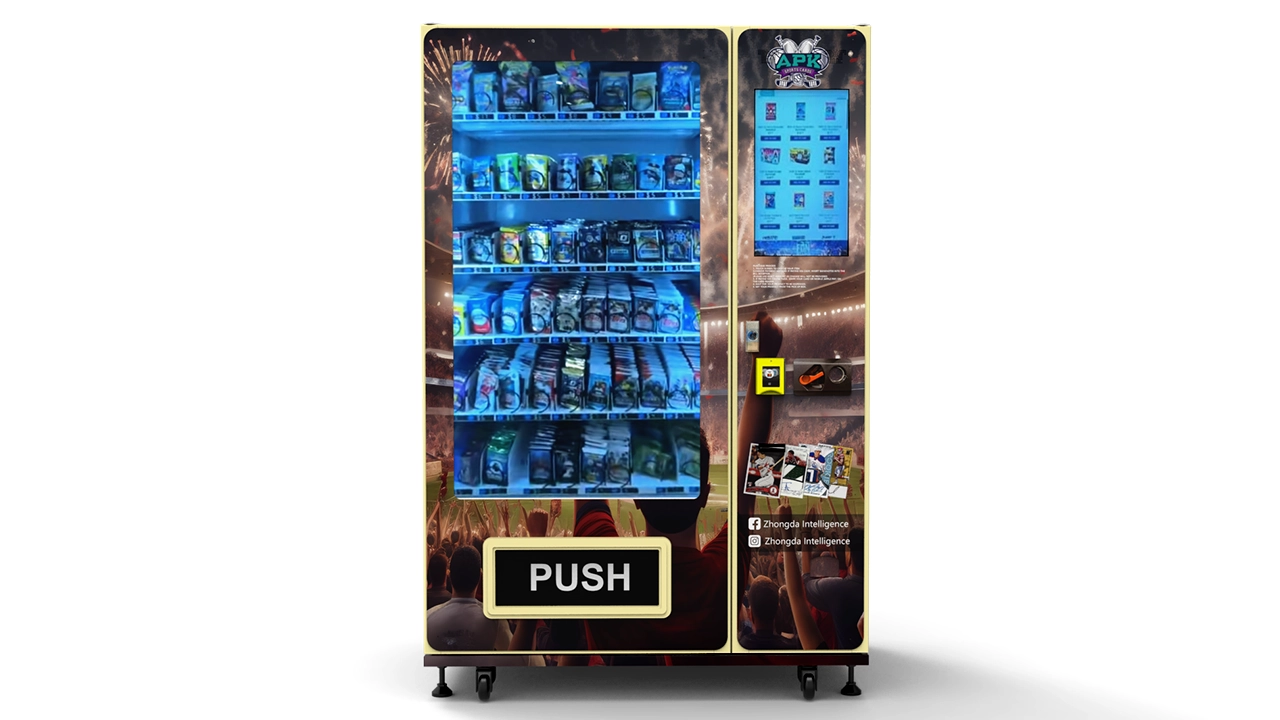
When I source machines directly, one manufacturer that has consistently delivered solid build quality without the inflated branding markup is Zhongda Smart. Their combi units have held up well in unconditioned locations where cheaper imports started failing within 18 months. Better hardware means fewer service calls, fewer refunds, and fewer claims. That is not a marketing point; it is a line item in your loss ratio.
Frequently Asked Questions
Which insurance company is best for a small vending machine business?
Nationwide is the strongest overall choice for most small routes because off-premises equipment coverage is standard and certificates of insurance are issued quickly. Hiscox and Next Insurance are better for solo operators who need instant coverage and do not carry perishable inventory. The Hartford is better once you have employees and a warehouse.
How much does vending machine insurance cost per year?
For 1–5 indoor snack machines, expect $350–$700 annually. For 6–15 machines with drinks and mixed locations, $700–$1,600. Routes with perishable food and 16–40 machines typically run $1,600–$4,500. These figures are based on my own route data and may vary significantly by location and claims history.
Do I need insurance if my vending machines are inside someone else's building?
Yes. The building owner's policy covers the building, not your equipment or your liability. If a customer is injured using your machine or your machine leaks and damages the floor, you are the responsible party. Most host locations require a certificate of insurance before they will sign a contract.
Does vending machine insurance cover stolen machines?
It depends on the policy. Business personal property coverage typically includes theft, but some carriers classify a machine removed from an unsecured location as "mysterious disappearance" and deny the claim. Confirm in writing that off-premises theft is covered before you place a machine at a low-security location.
Is spoilage coverage worth it for a small vending route?
If you stock perishable food, yes. A single compressor failure in summer can destroy $300–$600 in inventory. Spoilage endorsements typically cost $75–$250 per year for $5,000 in coverage. If you only run snacks and shelf-stable drinks, skip it.
Can I switch insurance carriers mid-year?
Yes, but check whether your current policy has a short-rate cancellation penalty. Most annual policies refund unused premium on a pro-rata basis, but some apply a short-rate penalty of 10–25%. Time a switch to your renewal date when possible.
How fast can I get a certificate of insurance for a new location?
Hiscox, Next, and Thimble issue certificates instantly online. Nationwide typically issues same-day through an agent. The Hartford usually takes one to two business days. If a host location needs proof within hours, that speed difference should factor into your carrier choice.
Does my personal auto insurance cover my vending route vehicle?
Almost never. Once a vehicle is used regularly for business, personal auto policies exclude coverage. You need a commercial auto policy. This is one of the most common and most expensive coverage gaps I see among small operators.