If you’re looking into how to start a trading card vending machine business, the honest answer is that it can be a solid side income or even a full-time operation, but only if you treat it like a retail business rather than a passive cash printer. I’ve spent over a decade placing automated retail equipment across the U.S. and Europe, and I’ve seen operators make real money with card machines, and I’ve also seen people lose their entire investment within six months because they bought the wrong equipment and put it in a dead location. The difference usually comes down to three things: your upfront cost structure, your site selection discipline, and how fast you can adapt your inventory to what actually sells. This guide is based on my own experience running these machines, not on manufacturer brochures.
Why Trading Card Vending Machines Are Different From Snack Vending
The first thing you need to understand is that a trading card vending machine is not a snack machine with different products inside. The economics are completely different. A snack machine has a low margin per item, high restock frequency, and predictable demand. A card machine has a high margin per item, lower restock frequency, but much more volatile demand. You are selling collectibles, not consumables. That changes everything about how you choose a location, how you price your products, and how you handle machine downtime.
When I started my first card vending operation in 2019, I made the classic mistake of treating it like my snack business. I placed a full-size machine in a suburban mall corridor with heavy foot traffic but zero collector demographic. The machine looked nice, the payment system worked, but nobody bought anything. After two months of near-zero sales, I moved it to a local game store that hosted weekly trading card tournaments. The difference was night and day. That same machine started generating over $1,200 a month in revenue with just a few hours of restocking per week.
That experience taught me a lesson that I still apply today: you are not selling cards, you are selling convenience to a specific type of buyer. The machine has to be where that buyer already spends time. A trading card vending machine is a self-service kiosk that lets collectors buy sealed packs, single cards, or booster boxes without waiting for a store clerk. It works because it removes friction. But it only works if the buyer is already nearby.
What a Trading Card Vending Machine Business Actually Looks Like
Let me give you a realistic picture of what this business involves on a day-to-day basis. You buy or lease a machine, you fill it with product, you place it in a retail location, and you collect money. But the operational reality is more complex. You need to manage inventory levels, track which products sell at which locations, handle payment processing fees, and deal with the occasional machine jam or card dispenser issue. If you are not comfortable with basic troubleshooting or willing to learn, this business will eat into your margins fast.
In my experience, a single machine placed in a good location can generate between $800 and $2,500 per month in revenue. But that is not profit. You have to subtract the cost of goods sold, which for trading cards is usually between 40% and 55% of retail price, depending on whether you buy wholesale or at retail. Then subtract your location commission, which typically ranges from 10% to 20% of gross sales if you are placing the machine in someone else’s store. Finally, subtract payment processing fees, which are usually around 3% to 5% per transaction.
So a machine doing $1,500 a month in gross sales might net you somewhere between $400 and $700 after all costs. That is not a get-rich-quick number, but it is a realistic one. If you scale to five or ten machines, the numbers become more interesting, but so do the operational headaches. You need to restock each machine at least once a week, sometimes twice if the location is strong. You also need to rotate inventory based on what the local community is collecting at that moment. A Pokémon heavy location will not necessarily buy Yu-Gi-Oh! packs, and vice versa.
Upfront Costs and Equipment Selection
Let me break down the costs because this is where most people get confused. A new trading card vending machine from a reputable manufacturer will cost you anywhere from $3,500 to $12,000, depending on the size, screen configuration, and payment options. I have seen cheaper machines online for under $2,000, but I would avoid those. They often have poor card dispensing mechanisms, weak software, and no after-sales support. In this business, the machine is your employee. If it breaks down, you lose revenue and trust with the location owner.
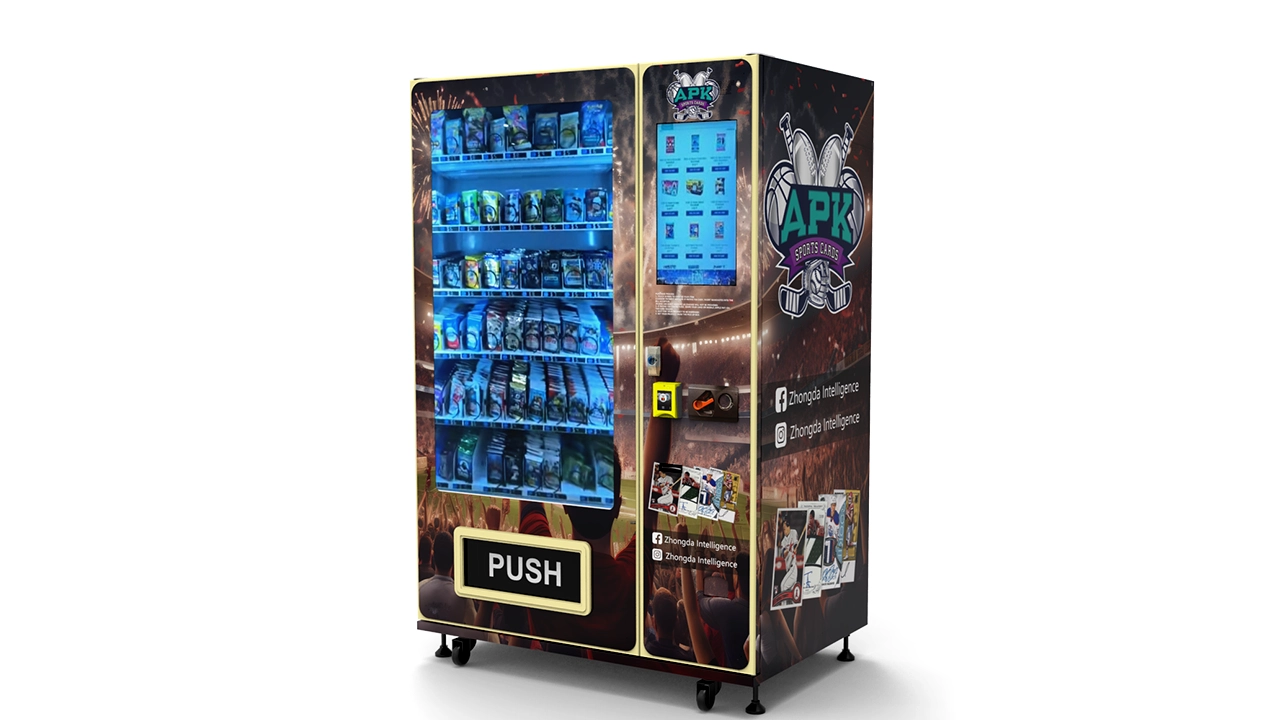
There are a few main types of machines you can choose from. The first is the full-size vending machine, which looks like a traditional snack vending machine but with a touchscreen and card dispensers inside. These are the most versatile because they can hold a large inventory, often 200 to 400 products, and they display items visually behind a glass window. The downside is that they are heavy, require more space, and cost more to ship and install.
The second type is the compact or countertop model. These are smaller, cheaper, and easier to place in a game store or comic shop. They hold maybe 30 to 60 items and are ideal for low-foot-traffic locations or for testing a new area without committing a lot of capital. The tradeoff is that you will restock them more frequently and you have less room to experiment with different product lines.
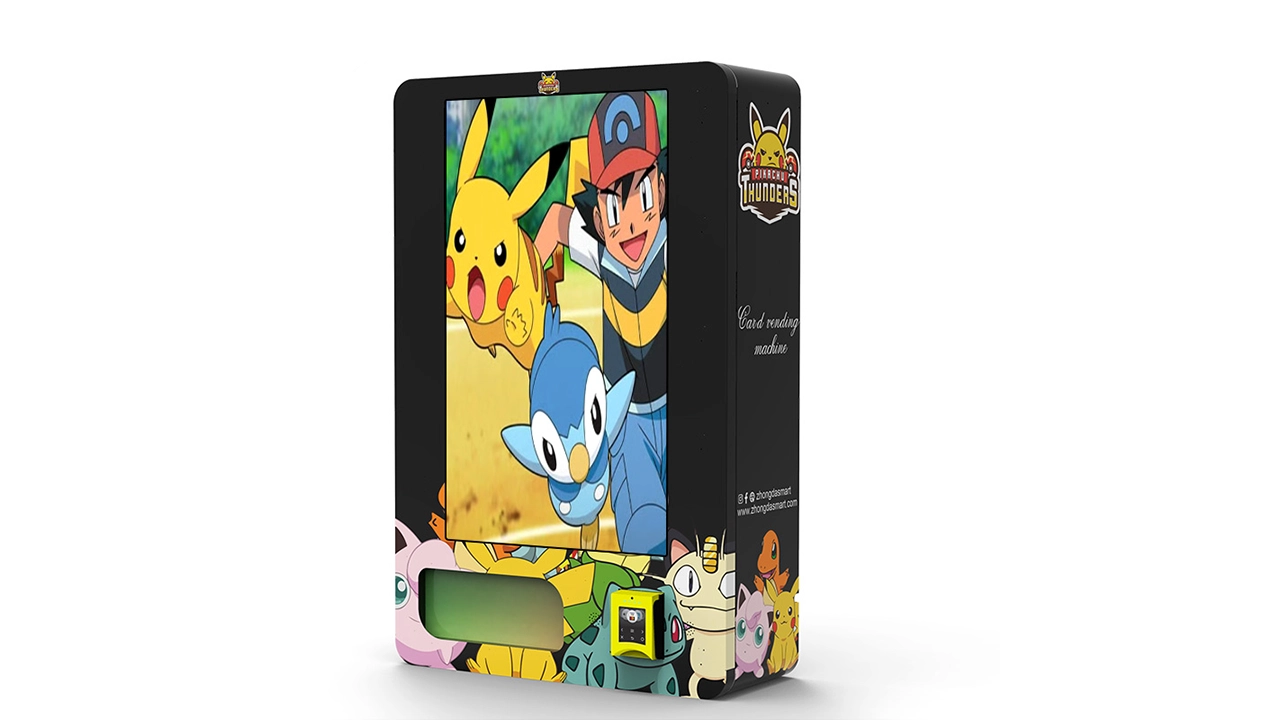
The third type is the wall-mounted card vending machine. These are relatively new and are designed for tight spaces like a narrow hallway or beside a checkout counter. They are a good option if you have a location that wants a machine but does not have floor space. However, they have the smallest inventory capacity, so you have to be very disciplined about what you stock. If you want to understand the differences in more detail, I have written about the wall-mounted card vending machine and its practical limitations in a separate post.
In terms of manufacturers, I have used a few over the years. One name that consistently comes up in the industry is Zhongda Smart. They are a Chinese manufacturer that has been shipping card vending machines to the U.S. and Europe for a while now. I have not used their machines personally, but I know several operators who have, and the feedback is generally positive on build quality and the touchscreen interface. If you are comparing suppliers, put them on your list, but do not skip the due diligence. Ask for reference customers in your country, request a video call to see the machine operating, and ask about spare parts availability.
Site Selection Is Everything
I cannot stress this enough: location is 80% of the business. You can buy the best machine, stock it with the hottest products, and still fail if the location is wrong. The opposite is also true. A mediocre machine in a great location will still make money. So how do you evaluate a location? Start with foot traffic, but not just any foot traffic. You need foot traffic from the right demographic. A mall with 10,000 daily visitors sounds great, but if most of those visitors are there for clothing or food, they are not your customers.
What you want is a location where people already buy trading cards, or where they gather to play games. Local game stores, comic book shops, hobby stores, and even some toy stores are prime candidates. The best scenario is a store that already sells cards but wants to extend its selling hours without adding staff. Your machine becomes an extension of their business. In that case, you can negotiate a commission split, usually 10% to 20% of gross sales, and the store benefits from having product available even when the counter is busy.
Another good location is a card show or a community center that hosts regular trading events. These are not permanent, but you can sign short-term agreements to place a machine for a weekend or a week. I have done this a few times and it can be a nice revenue spike, but it is not a stable base for a business. You want a mix of stable locations and occasional pop-up placements.
One thing I learned the hard way is to check the location’s actual sales data before signing anything. I once placed a machine in a comic shop that looked busy every time I visited. It turned out I was visiting on tournament days. On regular weekdays, the store was almost empty. My machine sat idle for a month before I pulled it. Ask the store owner for average daily sales numbers, or better yet, sit in the store for a few hours on a weekday and count the customers yourself.
Comparing Business Models: Own, Lease, or Revenue Share
When you are starting out, you have a few options for how to structure the business. You can buy your own machine and place it yourself, you can lease a machine from a supplier, or you can partner with a location that provides the space and you share the revenue. Each model has pros and cons, and the right choice depends on your capital and your risk tolerance.
| Model | Upfront Cost | Monthly Cost | Control Over Inventory | Profit Potential | Risk Level |
|---|---|---|---|---|---|
| Buy your own machine | $3,500 – $12,000 | Maintenance, restocking, payment fees | Full control | Highest, after break-even | High if location fails |
| Lease a machine | Low, often $500 – $1,500 deposit | $150 – $400 per month lease fee | Limited, depends on contract | Moderate, lease fee reduces margin | Lower, easier to exit |
| Revenue share with location | Minimal, often just inventory cost | 10% – 20% of gross sales to location | Shared, location may have input | Depends on sales volume | Low if sales are low |
From my experience, buying your own machine is the best path if you have the capital and you are confident in the location. The break-even point on a $6,000 machine with a monthly net profit of $500 is about 12 months. That is a reasonable timeline if you are patient. Leasing makes sense if you want to test the business without committing a large sum, but the lease fee eats into your margin, and you have less flexibility to move the machine if the location underperforms.
Revenue sharing is a good way to get started with almost no capital, but it only works if you have a strong relationship with the location owner. You are essentially putting your inventory and your time at risk, and the location owner is taking a cut for providing space. I have seen this model work well in game stores where the owner is actively engaged in the card community. But I have also seen it fail when the location owner loses interest and stops promoting the machine.
Cost Breakdown and Expected Returns
Let me give you a more detailed cost breakdown based on my actual operating experience. I am using a mid-range scenario: a full-size machine costing $6,500, placed in a local game store with a 15% commission agreement.
- Machine cost: $6,500 (one-time)
- Shipping and installation: $300 – $500
- Initial inventory: $1,500 – $2,500 (depending on product mix)
- Payment processing fees: 3% – 5% of gross sales
- Location commission: 10% – 20% of gross sales
- Maintenance and repair: $50 – $150 per month average
- Restocking labor: 2 – 4 hours per week per machine
If the machine does $1,500 in gross sales per month, your cost of goods sold is roughly $650 (assuming a 45% margin), the location commission is $225, and payment fees are around $60. That leaves about $565 before maintenance and labor. Subtract $100 for maintenance and you are left with roughly $465 in net profit per machine per month. At that rate, your initial investment of $8,500 (machine plus initial inventory) is paid back in about 18 months.
I want to be clear that these numbers are estimates based on my experience, not a guarantee. Some locations will do much better, especially during a new set release or a spike in card popularity. I have had months where a single machine did $3,000 in sales, and I have had months where the same machine barely did $400. The key is to be consistent with restocking and to track your sales data so you can adjust your product mix quickly.
Inventory Management and Product Selection
The biggest mistake I see new operators make is stocking their machine with whatever they can buy at retail price. That is a fast way to lose money. You need to buy at wholesale or at least at a discount that gives you a healthy margin. Trading card products are unique because the secondary market is volatile. A sealed booster box that you bought for $100 might be worth $150 a year later, or it might be worth $60 if the set is unpopular. You need to understand the market for each product line you carry.
In my experience, sealed product sells more consistently than single cards. Booster packs and booster boxes have a fixed price point and a known market value. Single cards are harder to price because they depend on condition and current demand. I do carry some single cards in my machines, but I limit them to high-demand cards that I know will sell quickly. The rest of the machine is sealed product.
Another thing to consider is product rotation. A machine that sits with the same inventory for months will lose momentum. Collectors want to see new products. I try to rotate at least 20% of my inventory every month, especially when a new set is released. This keeps the machine fresh and gives repeat customers a reason to check it regularly.
If you are new to this, start with a narrow product range. Focus on one or two card games that you know well, and expand from there. Trying to stock Pokémon, Yu-Gi-Oh!, Sports cards, and One Piece all at once is a recipe for overstock and slow-moving inventory. I have a detailed post on inventory management and product selection that goes deeper into this topic.
Payment Systems and the Unattended Retail Experience
The payment system is the heart of the user experience. If a customer walks up to your machine and the card reader is slow or rejects their card, they will not come back. I learned this lesson with my first machine, which had a cheap card reader that failed about once a month. Every failure meant lost sales and an annoyed location owner. I eventually replaced it with a more reliable reader, and the difference was immediate.
Most modern trading card vending machines come with a touchscreen, a card reader, and a cashless payment option. Some also support mobile payments like Apple Pay or Google Pay. In my experience, cashless is essential. Over 80% of my sales are paid by card or mobile wallet. Cash is still used, but it creates an extra burden because you have to empty the cash box regularly and count it manually.
You also need to think about the user interface. A machine with a confusing screen will drive customers away. The best machines have a simple menu: choose a product category, see what is available, swipe your card, and the product dispenses. If the machine has a touchscreen, make sure the software is responsive and the product images are clear. A 32-inch touchscreen is a good option because it gives you more room to display products and promotions, but it also costs more and uses more power.
Maintenance and Troubleshooting
No matter how reliable your machine is, it will break down eventually. Card dispensers get jammed, card readers fail, and screens freeze. The question is not whether you will have to deal with maintenance, but how prepared you are when it happens. I recommend buying a machine that uses standard parts that are easy to replace. Some manufacturers use proprietary parts that are expensive and hard to source, which is a nightmare when something breaks.
In my experience, the most common issues are card jams and sensor errors. A card jam usually happens when a pack is slightly too thick or the dispenser motor is worn. Most of the time, you can clear it by opening the machine and manually removing the stuck pack. Sensor errors are trickier because they often require recalibration. If you are not comfortable with basic electronics, find a local vending machine repair technician who can work on your machine. The cost for a service call is usually between $100 and $200, so it is worth learning how to do simple fixes yourself.
I also recommend keeping a small inventory of spare parts: an extra card dispenser motor, a card reader, and a power supply. These parts cost between $50 and $200 each, but they can save you weeks of downtime. A machine that is offline for two weeks can easily lose $300 in sales, so the spare parts pay for themselves quickly.
Common Mistakes and Lessons From the Field
Let me share a few real examples from my own experience, both good and bad. The first mistake was my early mall placement that I already mentioned. I lost about $1,200 in rent and inventory before I moved the machine. The lesson was simple: foot traffic is not the same as target traffic. Do not sign a lease or a placement agreement without verifying that the location has a collector demographic.
The second mistake was underestimating the impact of a new set release. I had a machine in a game store that was doing okay, but when a new Pokémon set was announced, I doubled my inventory order. The machine sold out within three days. I made a good profit, but I also missed out on more sales because I did not have backup inventory. Since then, I always keep a reserve of high-demand products in storage so I can restock quickly when a set goes viral.
On the positive side, my best decision was placing a machine in a hobby store that had a small but loyal community of sports card collectors. The store owner was skeptical at first, but after the first month, the machine generated over $1,800 in sales. The key was that the store already had a display case with sports cards, so the machine fit naturally into the shopping experience. The owner even started promoting the machine to his regular customers. That machine is still my best performer today.
Data Sources and Market Context
To give you a broader perspective, the vending machine industry has been growing steadily. According to Statista, the global vending machine market is projected to reach over $100 billion by 2027. The trading card segment is a small but growing part of that. The trading card market itself is also expanding. IBISWorld reports that hobby and toy retailers have seen steady growth, driven in part by the collectibles boom.
From a regulatory perspective, you do not need a special license to operate a vending machine in most U.S. states, but you do need a business license and you will need to collect sales tax on your sales. The U.S. Small Business Administration has a useful guide on the licenses and permits you may need. In Europe, the rules vary by country, but the Eurostat database has information on retail trade and vending machine regulations. I always recommend checking with your local tax authority before you start.
One thing to note is that the trading card market is cyclical. Booms and busts happen. When the market is hot, your machine can make a lot of money. When it cools down, sales will drop. You need to have a plan for the down cycle, whether that means diversifying into other collectibles like Funko Pops or sports memorabilia, or simply accepting lower revenue for a few months. A trading card vending machine business is not a set-and-forget investment. It requires ongoing attention to market trends.
Scaling and Long-Term Strategy
Once you have one machine running consistently, the natural question is whether to scale. I have seen operators grow from one machine to a fleet of twenty or more. The key to scaling is having a repeatable process. You need a system for site evaluation, a standard contract for location agreements, a reliable restocking schedule, and a way to track sales data across all your machines.
I use a simple spreadsheet to track each machine’s sales, inventory, and maintenance history. It is not fancy, but it works. When I look at expanding, I focus on locations that have the same characteristics as my best performing machine. That means a store with an existing card community, a reasonable commission rate, and a willingness to promote the machine. I avoid locations that are purely transactional, like a convenience store, unless they have a proven track record of selling collectibles.
Another consideration is whether to invest in a larger machine with more features. A machine with a larger screen and better software can attract more attention, but it also costs more. I have found that the return on investment for a premium machine with a touchscreen is worth it in high-traffic locations, but not in lower-traffic ones. You have to match the machine to the location.
Disclaimer
The figures and examples in this article are based on my personal operating experience and are not a guarantee of future results. Your actual costs, revenue, and profit will depend on factors such as location, product selection, market conditions, and your own operational efficiency. Always do your own research and consult with a financial professional before making any business investment.
Frequently Asked Questions
Do trading card vending machines actually make money?
Yes, they can make money, but not automatically. A well-placed machine in a location with a collector demographic can generate $800 to $2,500 per month in gross sales. Your net profit after product cost, location commission, and fees is typically $300 to $700 per machine per month. The key is site selection and inventory management.
How much does a trading card vending machine cost?
A new machine costs between $3,500 and $12,000, depending on size and features. Shipping, installation, and initial inventory will add another $2,000 to $3,000. You can buy used machines for less, but you risk higher maintenance costs and outdated payment systems.
How long does it take to break even?
With a typical net profit of $300 to $700 per month per machine, it will take 12 to 24 months to recover your initial investment. A strong location with high sales can break even faster, while a poor location may never break even.
Should a beginner buy or lease a machine?
If you are new to the business, leasing can be a safer way to test the waters because it requires less upfront capital. However, leasing reduces your monthly profit. If you have the capital and have identified a strong location, buying is the better long-term option.
Where is the best place to put a trading card vending machine?
The best locations are local game stores, comic book shops, hobby stores, and any place where trading card collectors already gather. Avoid general retail locations with high foot traffic but no collector demographic. Always verify the location’s sales data before committing.
What licenses and permits do I need?
In the U.S., you generally need a business license and you must collect sales tax. Some states may have specific vending machine regulations, so check with your local government. In Europe, rules vary by country, so consult your local business authority.
How do I choose a reliable vending machine supplier?
Ask for customer references, request a live video demonstration, and check whether spare parts are readily available. Manufacturers like Zhongda Smart are worth considering, but always do your own due diligence. Avoid suppliers that cannot provide local support or warranty service.
What should I do if my machine breaks down?
Start by troubleshooting the most common issues: card jams, sensor errors, and payment reader failures. Keep spare parts on hand and learn basic repairs. If you cannot fix it yourself, hire a local vending machine repair technician. A service call typically costs $100 to $200.
How can I reduce restocking and maintenance costs?
Choose a machine with reliable components and a simple design. Buy spare parts in advance to avoid downtime. Plan your restocking routes to minimize driving time. Track your sales data to avoid stocking slow-moving products that tie up your cash.