If you are searching for a Pokemon card vending machine for sale, the first thing I will tell you is to slow down. After over a decade in the vending industry, I have seen operators jump into this niche expecting a goldmine, only to realize the hardware is only half the battle. A trading card machine is not a passive ATM; it is a specialized piece of automated retail that demands the right location, a sharp eye on inventory, and a clear understanding of your true cost per unit. This guide walks you through what I have learned from both my failures and my wins in this space, so you can decide if this business is actually right for you before you wire a dime to any supplier.
Why Trading Card Machines Are a Different Beast
Traditional vending machines sell consumables like chips or soda, where the customer eats the product and buys again tomorrow. Card vending machines are totally different. You are selling a discretionary collectible, often to a younger demographic, and the transaction is driven by hype, scarcity, and the thrill of the chase. This changes everything about how you operate. You are not just a vendor; you are a retail curator.
In my experience, the people who succeed here are those who understand the secondary market for Pokemon cards. If you do not know what a "chase card" is, or you cannot tell the difference between a booster pack and a booster box, you are going to struggle. The machine is just the vehicle; the inventory is the engine. You need to be prepared to pivot quickly when a set flops, and you need the cash flow to buy the hot sets when they drop.
The Real Cost of Entry: Hardware, Shipping, and Setup
When you look at a Pokemon card vending machine for sale, the sticker price is often the least of your worries. I have seen cheap units listed for $3,000, but they are usually flimsy, poorly insulated, and have terrible card dispensing mechanisms. You need a machine that can handle the weight and size of booster packs without jamming. A good, dedicated card machine with a robust carousel or tray system will run you anywhere from $6,000 to $15,000 depending on the size and screen configuration.
Do not forget shipping and customs, especially if you are buying from overseas. I once bought a "deal" on a container unit that ended up costing me an extra $1,200 in freight and import fees. For a wall-mounted unit, you can often ship via LTL freight for a few hundred dollars, but the larger 32-inch touchscreen models are heavy. You need to factor in installation, too. If you are placing this in a mall, you might need a licensed electrician to run a dedicated circuit, which is another $500 to $1,000 in many markets.
On top of that, you have the initial inventory. To make a machine look full and professional, you need at least $2,000 to $3,000 in retail product. This is non-negotiable. A half-empty machine looks broken and kills consumer confidence. So, your realistic starting budget for a single, decent setup is around $10,000 to $15,000 before you see a single dollar in revenue.
Location: The Make or Break Factor
I cannot stress this enough: location is the single biggest determinant of whether your machine makes money. I have a machine in a suburban comic book store that does $1,500 a month, and I have a machine in a high-traffic mall that barely does $400 because the foot traffic was wrong. The mall had volume, but it was the wrong demographic—mostly office workers and window shoppers, not kids with allowance money or collectors.
You need to look for places where the target audience already congregates. Think hobby shops, gaming cafes, movie theaters, and bowling alleys. I have seen successful placements in laundromats, believe it or not, because parents are stuck there for an hour and kids are bored. The key is dwell time combined with disposable income. You want a spot where people have time to look at the screen and make an impulse decision.
Before you sign any lease or profit-share agreement, sit in the location for an hour. Watch the traffic. Talk to the store owner. Ask if they already sell cards over the counter. If they do, and they are selling out, that is a green light. If they don't, ask why. There might be a licensing issue with the mall, or the local market might be saturated.
Choosing the Right Machine Configuration
There is no one-size-fits-all machine. I have learned that the configuration needs to match the location's space and the expected transaction volume. For a small coffee shop or a barber shop, a wall-mounted card vending machine is often the smartest play. They take up minimal floor space, and the lower price point makes the entry barrier smaller.
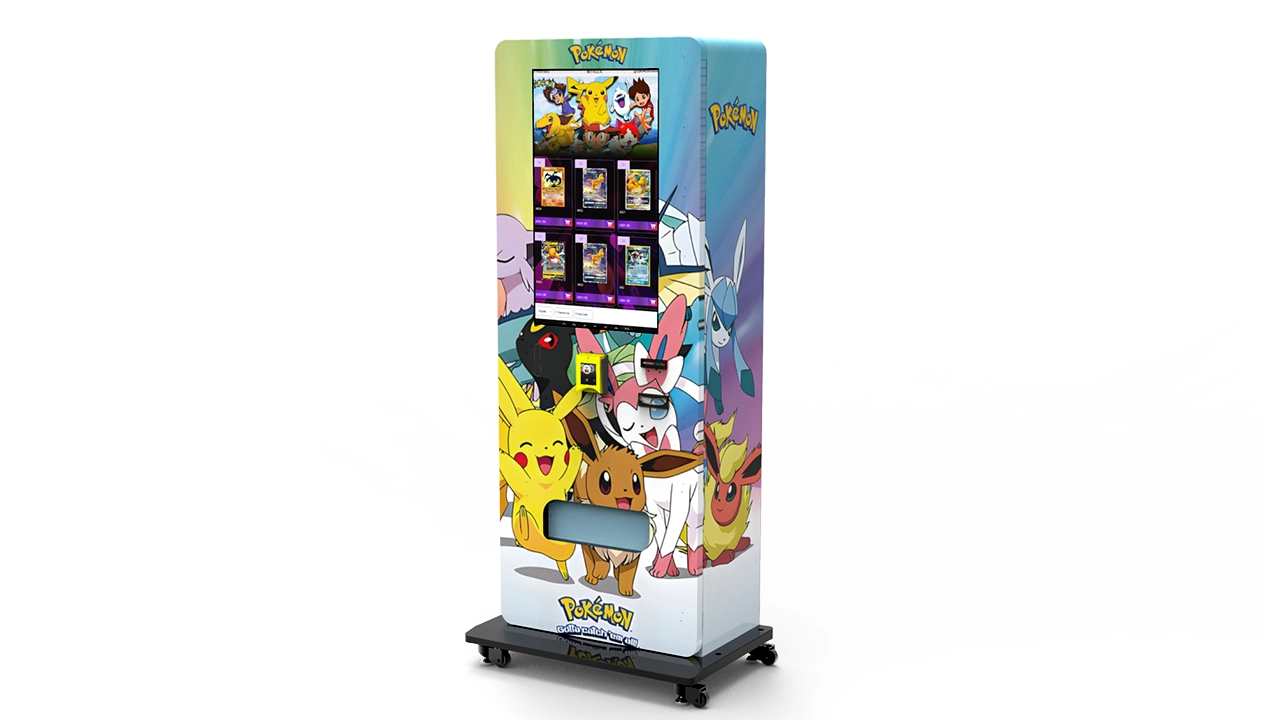
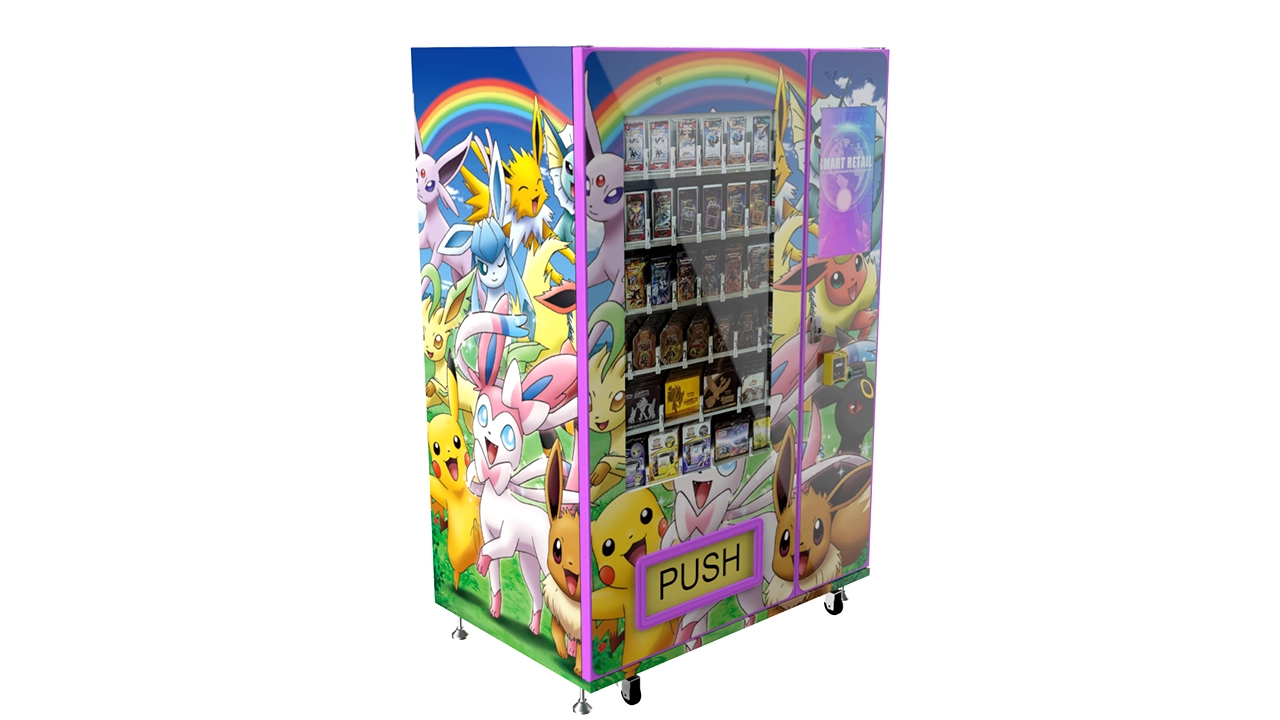
However, wall-mounted units have a smaller capacity. If you hit a hot streak and sell out in three days, you are losing money because you cannot restock fast enough. For high-traffic areas like malls or entertainment centers, you need the larger floor-standing models. The 32-inch touchscreen trading card vending machine is my go-to for these spots. The big screen allows you to display images of the cards inside, which is crucial because most kids don't know what a booster pack looks like from the outside. They need to see the artwork to get excited.
Touchscreen models also allow for better software integration. You can run promotions, show videos, and even rotate the product display remotely. This is a game-changer if you are managing multiple machines across town. The downside is that these units cost more, and the screens are an additional point of failure. I have had a screen go out on a busy Saturday, and it killed my sales for the whole weekend because people thought the machine was off.
Payment Systems and the Cashless Experience
In 2025, if your machine does not accept cards and mobile wallets, you are losing at least 30% of your potential sales. I learned this the hard way with an older machine I bought second-hand. It only took coins and bills, and the amount of kids who walked away because they didn't have cash was painful to watch. You absolutely need a modern card reader.
Look for a machine that supports NFC tap-to-pay, Apple Pay, and Google Pay. These are the standard payment methods for the younger generation. I also recommend installing a telemetry system that gives you real-time sales data and inventory levels. This is not a luxury; it is a necessity. Knowing that you are low on a specific SKU before you drive out there saves you time and gas money.
The software should also allow you to adjust pricing remotely. Card prices fluctuate based on the secondary market. If a set suddenly spikes in value, you want to be able to raise the price on the machine from your phone. If a set is not selling, you want to drop the price quickly to move the inventory. A machine without remote management is a boat anchor in this business.
Supplier Selection: Avoiding the Headache
I get asked all the time about who to buy from. I have imported machines from several Chinese manufacturers, and the experience varies wildly. I have had good luck with Zhongda Smart for their reliability on the mechanical side. Their card dispensing trays are solid, and they are willing to customize the software to your needs. But I will say this: always ask for a video call to see the machine running live before you pay a deposit. Photos can hide a lot of shoddy wiring.
When evaluating a supplier, ask about the warranty on the dispensing motor and the logic board. These are the two components that fail most often. A good supplier will offer at least a one-year warranty on these parts and will have a distributor in your country for spare parts. If they tell you that you can just order parts from China when something breaks, walk away. You cannot wait two weeks for a motor when your machine is down.
Check if the machine uses standard, off-the-shelf components. I once bought a machine that required a proprietary sensor that only the manufacturer sold. When it broke, I was stuck paying $80 for a part that should have cost $10. Stick to machines that use generic parts, or at least parts that are readily available on the open market.
Realistic Revenue and Profit Margins
Let's talk numbers, because that is what everyone cares about. In my experience, a well-placed card vending machine in a good hobby shop can generate between $800 and $2,500 in monthly revenue. The margin on trading cards is usually around 30% to 40% if you are buying at wholesale. This means the gross profit on that $1,500 month is roughly $500 to $600.
However, you have to subtract your costs. If you are paying rent or a profit share to the host location, that might be 10% to 20% of your gross. Then you have electricity, which is minimal, but it adds up. And you have to account for shrinkage—cards that get stuck, damaged in the mechanism, or stolen. I usually budget about 5% of revenue for shrinkage and breakage.
So, realistically, a single machine might net you $300 to $400 a month in pure profit. That is not a life-changing amount, but it is a solid side income. The real money comes from scaling. If you have five machines doing $400 net each, that is $2,000 a month passive-ish income. But the work is not passive. You are driving around, restocking, and rotating inventory.
Payback Period and ROI Expectations
Based on my numbers, you are looking at a payback period of 12 to 18 months for a new machine. This is assuming you hit your targets. If you buy a used machine for half the price, you might recoup your investment in 8 to 12 months, but you take on the risk of mechanical failures. I have a rule of thumb: if the machine is not paying for itself within 18 months, the location is wrong, or the product mix is wrong, and you need to move it.
Do not believe anyone who tells you that you will make your money back in 3 months. That is fantasy. The only way that happens is if you stumble into a viral Pokemon craze in a location that has zero competition, which is rare. Be conservative in your projections. Plan for the worst, and if the machine does better, you are pleasantly surprised.
Self-Op vs. Profit Share vs. Lease
There are three main ways to structure a placement: self-operating, profit sharing, or leasing the machine to a business. I have done all three. Self-operating is the most profitable per machine, but it takes the most time. You are responsible for everything, from sourcing the cards to fixing the machine at 9 PM on a Friday.
Profit sharing is my preferred method for busy locations. You put the machine in for free, and the host business gets a cut of the sales. This lowers your upfront rent risk, and the host has an incentive to keep the area clean and point customers to the machine. I usually offer a 10% to 15% cut of gross sales. It is a win-win if the host is engaged.
Leasing the machine is the most hands-off approach, but the margins are thinner. You rent the machine to a business for a flat monthly fee, and they are responsible for filling it. This is great if you want to just sell hardware, but you lose the recurring revenue from card sales. For most operators, I recommend starting with self-op or profit share to maximize your learning curve.
The Maintenance and Repair Reality
Machines break. It is a fact of life. I remember the first time I got a jam in a card dispenser; I panicked and thought I had ruined the whole unit. In reality, it was just a card that had a bent corner, and it was stuck on the sensor. You need to be handy enough to open the machine, clean the sensors, and clear jams. If you are not mechanically inclined, budget for a vending machine repair service, which will cost you $100 to $150 per visit.
To minimize breakdowns, I recommend a strict cleaning schedule. Dust is the enemy. Card dust from the packs gets into the sensors and causes false readings. I clean the inside of my machines with compressed air every two weeks. I also lubricate the moving parts sparingly, because too much oil attracts more dust.
Software updates are another thing. The card readers and the touchscreen systems need updates. Do not ignore them. An outdated system might have security vulnerabilities, or it might stop communicating with the payment processor. I always update my machines during off-hours to avoid downtime during peak sales times.
Inventory Management and Restocking Efficiency
Inventory is where most new operators lose their shirt. You cannot just fill the machine with random booster packs. You have to analyze sales data. I use a simple spreadsheet to track what sells and what sits. In my experience, the newest sets sell fast for the first two weeks, then sales taper off. Older sets become "filler" that moves slowly but still makes money.
I also recommend a rotating stock strategy. Do not let the machine sit static. Every time you restock, change the arrangement. Put the hottest items at eye level. If you have a touchscreen, use it to advertise the new arrivals. This creates a sense of freshness and urgency.
Restocking frequency depends on volume. A high-volume machine needs attention every 3 to 4 days. A slow machine might only need a visit every 10 days. But you should check the telemetry daily. If you see a specific SKU is down to 10% stock, you need to get there ASAP, because missing a sale is the same as losing money.
Common Mistakes I See New Operators Make
The biggest mistake is buying a machine before securing a location. I did this with my first unit. I bought it, and then spent three weeks scrambling to find a spot. I ended up placing it in a location that was not ideal just to get it out of my garage. That machine lost money for six months before I moved it.
The second mistake is overpaying for inventory. I have seen operators buy boxes of cards at retail price from big-box stores, thinking they can flip them at a margin. That does not work. You need wholesale access. If you do not have a distributor, you are going to be eating razor-thin margins.
The third mistake is ignoring the local market. A machine in a predominantly Magic: The Gathering area will not sell Pokemon well. I run a mixed machine in some locations, but in others, I specialize. You have to know your audience. I have a trading card vending machine in a sports memorabilia shop that sells mostly sports cards, and it does great. But I would never put that same stock in a comic shop.
Data-Driven Adjustments and Scaling Up
Once you have a machine running, the data is your best friend. I look at the weekly sales report like a hawk. If a set is not selling, I discount it or move it to a different machine. If a set is selling out, I double down on the next shipment. This is not a "set it and forget it" business. It is a constant cycle of analysis and adjustment.
Scaling up is about replicating success. Once I found a location and a product mix that worked, I looked for similar locations. I did not just randomly place machines. I targeted the same type of businesses in different towns. This allowed me to streamline my restocking routes and my inventory purchasing.
I also use the data to negotiate better terms with my suppliers. If I can show a distributor that I sell $5,000 a month of their product, I can ask for a better wholesale price. This increases my margin, which is the only way to stay profitable when sales dip.
Comparing Your Options: A Quick Reference
| Machine Type / Model | Initial Cost (Hardware) | Monthly Revenue Potential | Typical Net ROI Time | Best Use Case |
|---|---|---|---|---|
| Wall-Mounted Card Machine | $5,000 - $8,000 | $400 - $800 | 18 - 24 months | Low-footprint spots like barbershops, cafes |
| Standard Floor Unit (Non-Touch) | $8,000 - $12,000 | $800 - $1,500 | 12 - 18 months | Hobby shops, game stores |
| 32-Inch Touchscreen Model | $12,000 - $18,000 | $1,500 - $2,500 | 10 - 15 months | Malls, entertainment centers, high-traffic retail |
Legal and Compliance Considerations
Do not overlook the legal side. In the US, you need a sales tax permit for the state where the machine is located. The machine itself does not pay tax, but you are responsible for remitting the sales tax on the retail transactions. In the EU, the rules vary by country, but you generally need to register for VAT. Check with the local chamber of commerce or a tax advisor.
You also need to consider the physical safety of the machine. Ensure it is anchored to the floor or wall to prevent tipping. This is a liability issue. If a machine falls on a child, you are in deep trouble. I always use the safety brackets provided by the manufacturer.
If you are placing the machine in a school or a venue that has strict rules about gambling, check the local regulations. Some jurisdictions classify card vending machines under "gaming" laws because of the random nature of the packs. This is a gray area, and I have seen operators get fined for not having the right license. When in doubt, pay for a consultation with a local attorney who understands automated retail.
Is This Business Right for You?
I will be honest: this is not a get-rich-quick scheme. It is a real business that requires capital, time, and a willingness to learn. But if you enjoy the hobby, or you are willing to learn the market, it can be a rewarding side income that grows into something bigger. The key is to treat it like a business from day one. Do your due diligence, run the numbers, and do not let shiny hardware cloud your judgment.
I have seen too many people buy a machine because it looks cool and then realize they hate dealing with inventory. If you are not excited about sorting through booster boxes and checking price charts, you might be better off investing your money elsewhere. But if you are ready to put in the work, the card vending machine sector offers a unique niche that is still under-penetrated in many markets.
FAQ: Common Questions from New Buyers
Are vending machines actually profitable?
Yes, they can be, but it is not guaranteed. Profitability depends on location, product selection, and your ability to manage costs. In my experience, a single machine nets $300 to $400 a month after all expenses. Scaling to multiple machines is where the real income is.
How much does a card vending machine cost?
A new, reliable machine costs between $6,000 and $18,000 depending on the size and features. Wall-mounted units are cheaper, while large touchscreen models are at the top end. You also need to budget for shipping, installation, and initial inventory, which adds $3,000 to $5,000 to your startup costs.
How long does it take to recoup my investment?
Most operators see a payback period of 12 to 18 months. If you buy used equipment or secure an exceptional location, you might do it in 8 to 12 months. Be wary of anyone promising a 3-month payback; that is not realistic in most cases.
Should I buy or lease the machine?
If you are new, I suggest buying a single machine to learn the ropes. Leasing is good for scaling later when you have proven locations and want to reduce capital outlay. Leasing usually means lower margins per machine, but it spreads your risk.
Where is the best place to put the machine?
Look for locations with high foot traffic and a demographic that matches card collectors. Hobby shops, gaming cafes, movie theaters, and family entertainment centers are my top choices. Avoid places where the audience is mostly adults without interest in collectibles.
What permits or licenses do I need?
You need a sales tax permit for your state or country. Some areas have specific regulations for automated retail, and you might need a vending machine license. Check with your local business licensing office. If you place the machine in a mall, they might have their own insurance requirements.
How do I choose a reliable supplier?
Ask for a live video demonstration of the machine working. Check if they have a local service center or a distributor for spare parts. Look for a warranty on the motor and logic board. I have had good experiences with Zhongda Smart for their mechanical reliability, but always do your own background check.
What do I do if the machine breaks down?
First, check the telemetry to see if it is a minor jam. If it is a hardware failure, you will need to either fix it yourself or call a vending machine repair technician. Keep a stock of common spare parts like sensors and belts to reduce downtime.
How can I reduce restocking and maintenance costs?
Use a machine with remote telemetry to monitor inventory levels. This prevents unnecessary trips. Also, standardize your product mix so you are not managing dozens of different SKUs. Fewer SKUs mean easier restocking and less waste.
Disclaimer: The figures and insights in this article are based on my personal experience as a vending operator and are provided for general informational purposes only. They do not constitute financial advice. Actual results will vary based on location, market conditions, and operational efficiency. Always conduct your own research and consult with a professional before making significant business investments.