If you are reading this because you are thinking about buying a vending machine for Pokemon booster packs, the first thing I will tell you is this: it is not a passive income machine, but it is a real business with real margins if you treat it like one. I have been in the automated retail game for over a decade, and I have watched the trading card side of this industry explode since 2020. The biggest mistake newcomers make is assuming that because the product is hot, the location does not matter. That is wrong. The second mistake is buying the wrong piece of equipment for the wrong spot. In this guide, I am going to walk you through exactly how to choose a vending machine for Pokemon booster packs based on what I have learned from both my wins and my expensive mistakes.
Why Trading Card Vending Machines Are Not a Fad
I remember when people told me that selling cards in a vending machine would never work because collectors want to feel the pack and look at the artwork. That was true in 2015. It is not true anymore. The shift happened when sealed product became an investment vehicle. People are not just buying Pokemon packs to open them; they are buying them because a sealed booster box from 2016 is worth ten times what it retailed for. A vending machine solves a huge problem for this market: it prevents tampering and guarantees that the product inside has not been weighed or searched. That trust factor is why automated retail has become a standard channel for card distribution.
From an operational standpoint, the economics work because the average transaction is low but the foot traffic is high. A booster pack at retail price is around four to six dollars, and the margin on that is thin. But when you mix in elite trainer boxes, booster bundles, and the occasional high-ticket sealed item, your average ticket climbs. In my experience, a well-placed card vending machine can generate anywhere from 1,500 to 4,000 dollars a month in revenue, but that is heavily dependent on the location and the restock schedule. The key is to understand that you are not running a convenience store; you are running a specialty retail kiosk that happens to be unattended.
The First Decision: Equipment Type and Configuration
Before you even think about where to put the machine, you have to decide what kind of machine you are going to buy. There is a massive difference between a spiral snack machine retrofitted for cards and a purpose-built trading card vending machine. I have seen both, and I can tell you that the retrofit route is a trap. Card packaging is flat, light, and easily jammed in a spiral mechanism designed for soda cans or chips. You need a machine that uses a tray-based or carousel-based system that can handle the dimensions of a booster pack without bending the corners.
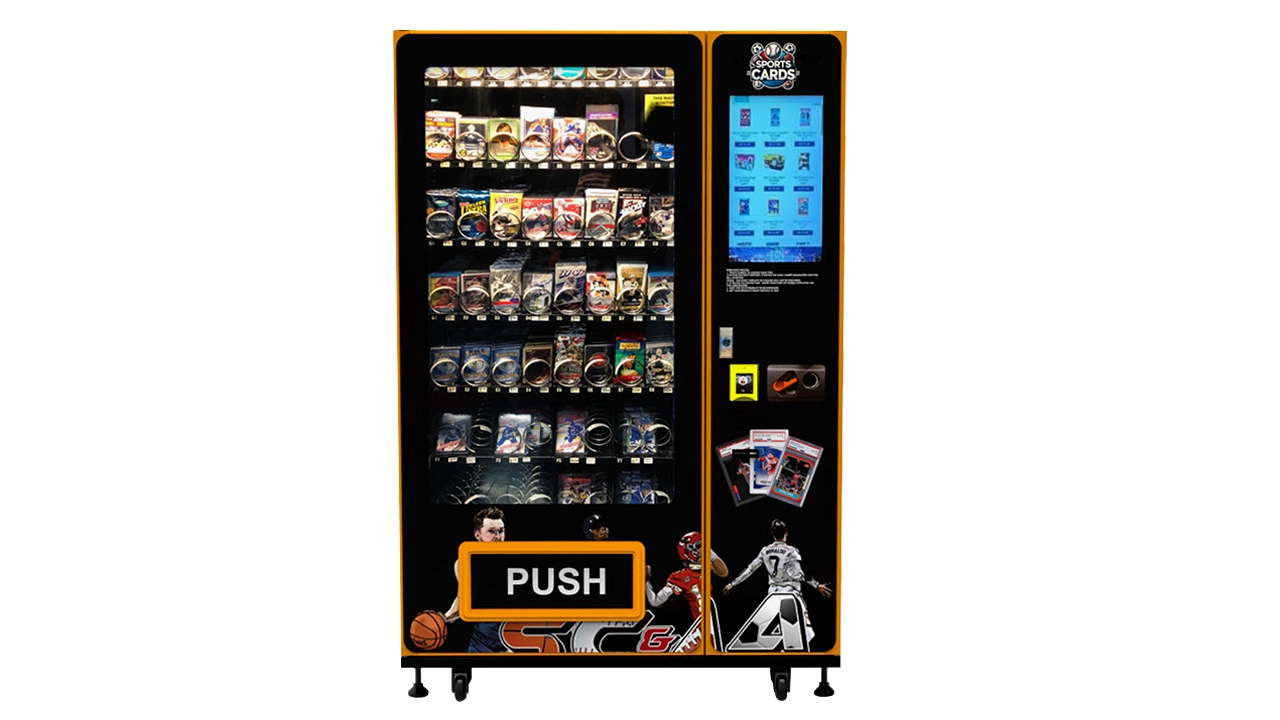
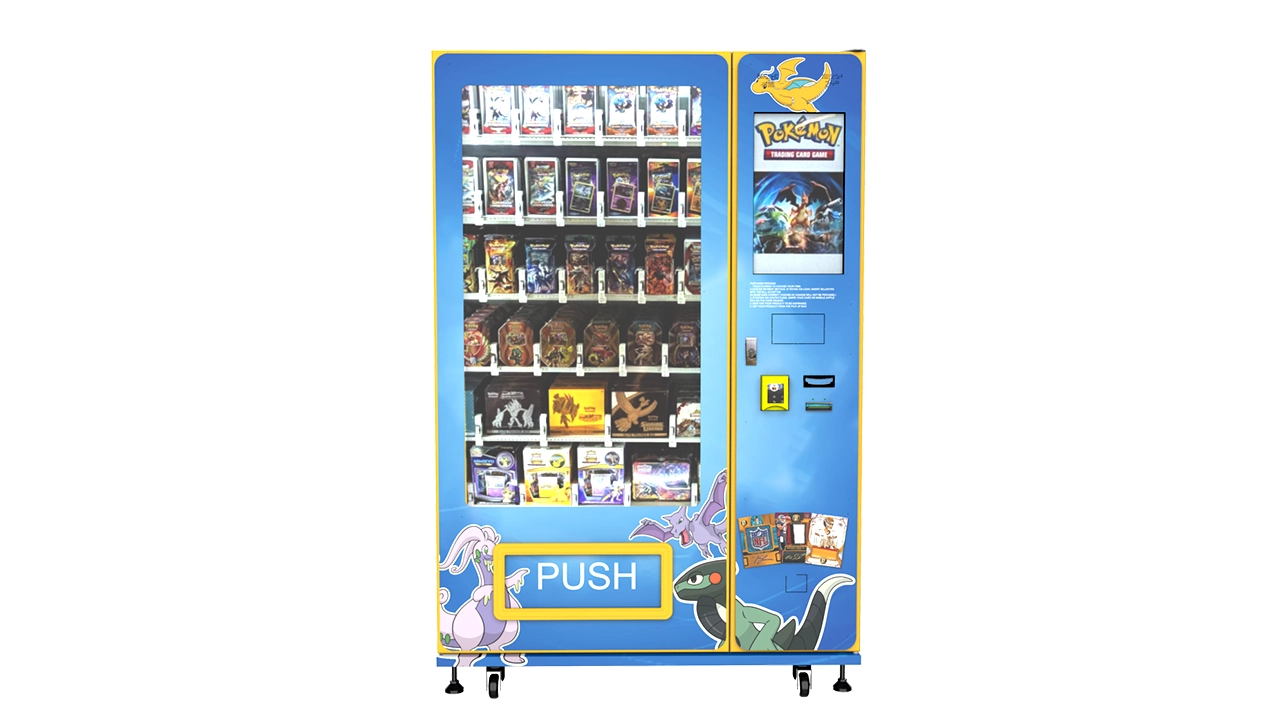
There are three main form factors you will encounter in this market. The first is the full-size kiosk, usually around 50 inches wide, with a large touchscreen and multiple trays. This is what you want for a high-traffic mall or a large retail store. The second is the wall-mounted card vending machine, which is smaller and designed to fit into tight spaces like a game store or a convenience store corner. The third is a hybrid machine that mixes cards with other sealed products like sports cards or even small toys. I have found that the wall-mounted option is the best entry point for a first-time operator because it lowers the barrier to entry and allows you to test multiple locations without tying up all your capital in one giant kiosk.
Screen Size and User Interface Matter More Than You Think
I have learned this the hard way. A machine with a small, dim screen will not attract attention. The screen is your storefront. If the display is bright and the images of the cards are sharp, people will stop and look. If it looks like an ATM from 1995, they will walk past. I recommend a 32-inch touchscreen or larger for any machine that will be placed in a public setting. The interactive element is crucial because it lets customers browse the inventory without feeling pressured. You can read more about the specific benefits of a 32-inch touchscreen trading card vending machine if you are comparing specs, but the short version is that it increases dwell time, and dwell time translates to sales.
Another thing to consider is the delivery mechanism. Some machines use a robotic arm that picks the item and drops it into a bin. Others use a simple tray that pushes the product forward. The robotic arm looks cooler and is more secure, but it is also more complex and more expensive to repair. The tray system is more reliable, but it limits the size of the product you can sell. For Pokemon booster packs, you do not need a robotic arm. A tray system is fine and will save you money on maintenance. I only recommend the robotic arm if you plan to sell larger items like collector boxes or if you want the wow factor to draw people in.
Location Evaluation: The Real Estate Rule
I cannot stress this enough: location is 80 percent of the equation. You can have the best machine in the world, but if it is sitting in a dark corner of a strip mall that gets no foot traffic, you will lose money. I once placed a machine in a comic book store that had a loyal customer base but only got about 50 visitors a day. The machine did okay, but it was not great. Then I moved it to a mall kiosk near the food court, and the same machine did three times the volume. The product did not change. The machine did not change. Only the foot traffic changed.
When I evaluate a location, I look for three things: daily foot traffic, the demographic match, and the operating hours of the surrounding businesses. For Pokemon cards, you want a location that gets families, teenagers, and young adults. A grocery store is not ideal because the demographic is too broad and the customers are there to buy food, not collectibles. A hobby shop is great, but the market may already be saturated. The sweet spot in my experience is a large retail store like a Walmart or Target, but those are hard to get into. The next best is a movie theater, a bowling alley, or a family entertainment center. These places have the right demographic and they have idle time, which is when people browse and buy.
I also check the average dwell time. If people are walking past quickly because they are on their way to a specific store, that is bad. If they are wandering around with no clear purpose, that is good. A simple way to measure this is to stand near the proposed location for an hour and count how many people walk by and how many of them look like they are browsing. I have done this more times than I can count, and it has saved me from making several bad investments.
Rent, Revenue Share, and Placement Costs
Do not pay a flat high rent for a card vending machine location. The industry standard for these machines is either a small flat fee or a percentage of sales. I prefer a revenue share model where the host business gets 10 to 15 percent of gross sales. This aligns your interests with theirs. If you pay a flat rent, you are taking all the risk. If the machine does poorly, you are still paying rent. With a revenue share, the host is motivated to help you succeed because they only make money when you make money.
I have seen hosts ask for as much as 30 percent, and I walk away from those deals. The margin on Pokemon products is not that high, and you still have to pay for electricity, maintenance, and restocking labor. A good rule of thumb is that your total location cost should not exceed 15 percent of your gross revenue. If it does, your profit margin will be too thin to justify the effort.
Cost Breakdown and Return on Investment
Let us talk real numbers. Based on my experience and the current market, a new, purpose-built trading card vending machine will cost you anywhere from 6,000 to 15,000 dollars depending on the size, screen, and features. A used machine can be had for 3,000 to 7,000 dollars, but you are taking on the risk of unknown wear and tear. I have seen operators buy used machines and then spend another 1,500 dollars on repairs in the first six months. That is not a bargain.
On the revenue side, I have seen single machines gross anywhere from 800 dollars a month in a bad location to over 5,000 dollars a month in a prime spot. The average that I have observed across my own operations and those of my peers is around 2,000 to 3,000 dollars a month. The gross margin on Pokemon booster packs is usually around 30 to 40 percent if you are buying from a distributor and not paying scalper prices. This means your gross profit on a 2,500 dollar month is around 875 to 1,000 dollars. After you subtract location costs, electricity, and your time for restocking, you are looking at a net profit of maybe 500 to 700 dollars a month per machine.
This is why the payback period is not as fast as some sellers claim. If you buy a machine for 8,000 dollars and net 600 dollars a month, your payback period is around 13 to 14 months. That is not bad, but it is not the get-rich-quick scenario that some websites promise. I have had machines that paid for themselves in eight months, and I have had machines that took 18 months. It all depends on the location and how disciplined you are with restocking and inventory management.
According to a report from IBISWorld, the vending machine operators industry in the US has grown steadily over the past five years, and the shift toward specialized and automated retail solutions is a key driver. Additionally, Statista data shows that the trading card market has seen a significant surge in value, with the global market expected to grow substantially through 2027. These are the tailwinds that make this business viable, but they do not guarantee individual success.
Inventory Sourcing and Pricing Strategy
You cannot just buy Pokemon products at retail and resell them in a machine. You need to source from a distributor or a wholesale supplier. This is where many beginners fail. They try to buy from Target or GameStop and then mark up the price, but the margin is too thin. You need to establish a wholesale account with a distributor that supplies trading cards. This usually requires a business license and proof that you are a registered business. The U.S. Small Business Administration has a helpful guide on how to register a business and obtain the necessary licenses, which is a good starting point if you are new to this.
Your pricing strategy needs to be competitive but also account for the convenience factor. You cannot charge 20 percent above retail and expect people to buy. I have found that pricing booster packs at retail or slightly below retail works best. The goal is volume, not margin per pack. You make your money on the higher-ticket items like booster boxes and elite trainer boxes, where the margin is larger and the customer is willing to pay a premium for the convenience of not having to hunt for them online.
I also recommend keeping a small inventory of older, out-of-print sets. These have a higher resale value and attract serious collectors. But be careful with this. If you hold onto inventory for too long, you tie up your cash. I have a rule: if a product has not sold in 60 days, I rotate it out or discount it. Stale inventory is the enemy of cash flow.
Maintenance, Repairs, and the Reality of Machine Downtime
Every machine will break down eventually. It is not a matter of if, but when. The most common issues are card jams, payment system failures, and screen glitches. I remember one time I had a machine in a mall that jammed on a booster pack, and the customer called the mall security thinking it was a robbery. It was a mess. The mall manager was not happy, and I had to pay a technician 200 dollars to come out and clear the jam. That was a lesson in the importance of having a reliable vending machine repair service on call. Do not try to fix these machines yourself unless you are technically inclined. The electronics are sensitive, and you can do more damage than good.
To reduce downtime, I recommend buying a machine from a reputable manufacturer that has a network of local service technicians. This is one of the reasons I have gravitated toward machines from Zhongda Smart. They have a solid reputation for building durable equipment, and their after-sales support is better than most. I am not saying they are the only option, but I have had fewer issues with their machines than with some of the cheaper imports I tried in my early days. You can find more details on their specific models if you want to compare, but the key takeaway is to buy from a company that will answer the phone when your machine breaks.
I also recommend buying an extra spare parts kit. This should include a spare card tray, a spare power supply, and a few sensors. These are the parts that fail most often, and having them on hand can save you days of downtime. A machine that is down is not making money, and in a prime location, every day of downtime is a permanent loss of revenue.
Self-Operated vs. Hosted vs. Revenue Share Models
There are three ways to run this business. You can self-operate, which means you own the machine, you find the location, and you handle all the restocking and maintenance. This gives you the highest margin but also the highest time commitment. You can host, which means you place your machine in an existing business and split the revenue with them. This reduces your margin but also reduces your risk and your time commitment. Or you can lease a machine from a provider, which means you pay a monthly fee and they handle everything. This is the lowest margin but also the lowest involvement.
I have done all three, and I can tell you that the self-operate model is the only one that makes sense if you want to build a real business. The revenue share model is good for testing a location, but it is not a long-term strategy. The lease model is a waste of money because you are building equity for someone else. If you are new, I suggest starting with one self-operated machine in a good location. Learn the ropes, understand the restocking cadence, and then expand.
| Model | Initial Cost | Monthly Margin | Time Commitment | Risk Level |
|---|---|---|---|---|
| Self-Operated | 6k - 15k | High | High | High |
| Revenue Share | 6k - 15k | Medium | Medium | Medium |
| Leased | Low monthly | Low | Low | Low |
Payment Systems and Security
The payment system is the most critical component of your machine. If it is slow or unreliable, customers will walk away. I recommend a payment system that accepts credit cards, mobile payments, and contactless methods. Cash is becoming less important, but I still keep a cash acceptor for younger customers who may not have a card. The new generation of payment systems is much faster and more reliable than the old ones, but they also require a stable internet connection. Make sure the location has Wi-Fi or a cellular signal that is strong enough to process transactions quickly.
Security is another issue. Card machines are targets for theft because the products inside are valuable and easy to resell. I have had machines vandalized, and I have had machines broken into. The best deterrent is a machine with a heavy gauge steel body and a high-quality lock. I also recommend installing a camera above the machine if the location allows it. This does not prevent all theft, but it does deter casual criminals.
Common Mistakes I See New Operators Make
The first mistake is buying a machine before securing a location. I have seen people buy a machine and then spend months trying to find a place to put it. This is backwards. Secure the location first, then buy the machine. The second mistake is buying a machine that is too small. A small machine may seem like a good way to test the waters, but it limits your revenue potential and you will outgrow it quickly. The third mistake is not having a restocking schedule. You need to visit your machine at least once a week, and more often if it is in a high-traffic location. An empty machine is a lost opportunity.
I also see operators fail because they do not track their sales data. You need to know which products are selling and which are not. This is not a hobby; it is a business. I keep a spreadsheet for every machine, and I review it every week. If a product is not selling, I replace it. If a machine is underperforming, I move it. This is the only way to survive in this industry.
How to Choose a Vending Machine for Pokemon Booster Packs: Final Advice
If you are serious about this, I recommend starting small and scaling slowly. Buy one machine, place it in a good location, and learn the operational rhythm. Do not try to build an empire overnight. The people who succeed in this business are the ones who treat it like a business, not a lottery ticket. The ones who fail are the ones who buy a machine on a whim and expect the money to roll in without any effort.
I also want to be clear about the regulatory side. Depending on where you live, you may need a business license, a sales tax permit, and possibly a vending machine permit. Check with your local municipality before you buy anything. The U.S. Small Business Administration has a useful page on vending machine regulations that is worth reading. In the EU, the rules vary by country, but the general principle is that you need to register your business and comply with local tax laws. This is not complicated, but it is necessary.
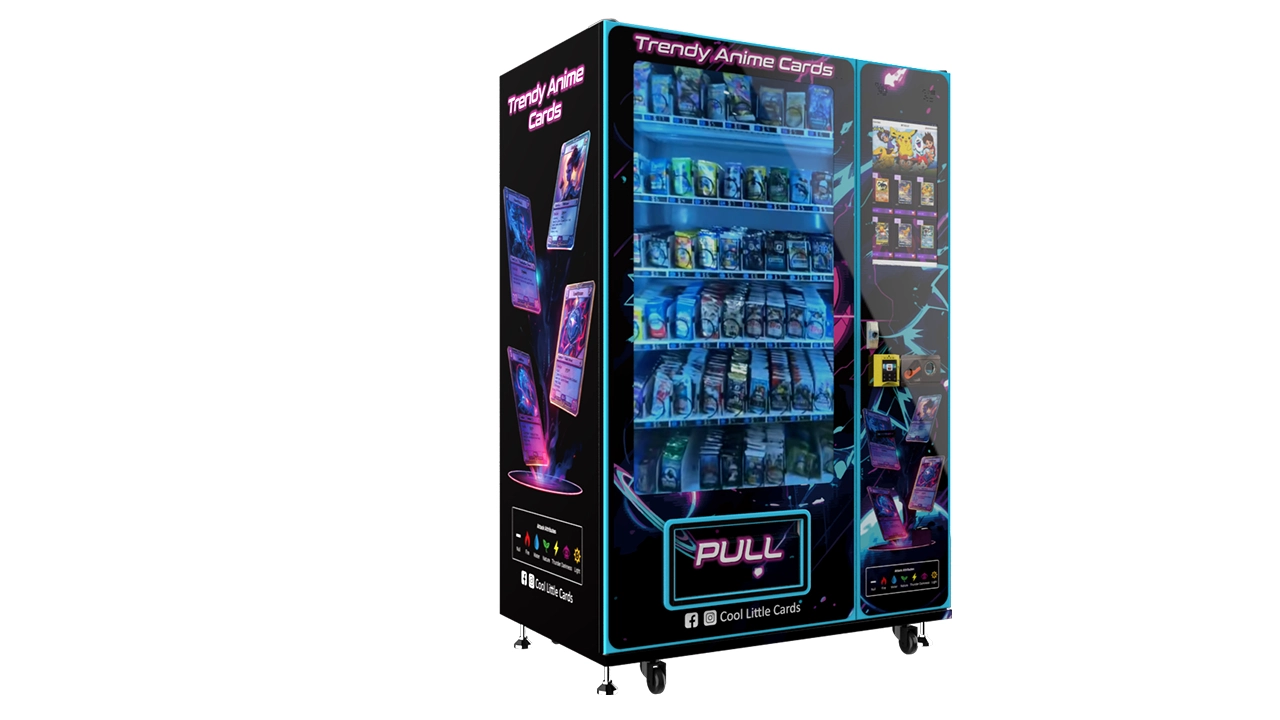
Finally, I want to mention that the market for Pokemon cards is cyclical. What is hot today may not be hot next year. Do not over-invest in a single product line. Diversify into sports cards, Yu-Gi-Oh, and even non-card collectibles if your machine has the capacity. This will protect you from a downturn in any single market.
I have been doing this for a long time, and I have seen the ups and downs. The card vending machine business is not a get-rich-quick scheme, but it is a legitimate way to make a living if you are willing to put in the work. The machines are reliable, the demand is real, and the margins are acceptable. Just do your homework, choose your locations wisely, and never stop learning.
Disclaimer: The figures and experiences shared in this article are based on my personal operational history and industry observations. They are not guarantees of future performance. Costs, revenues, and payback periods vary significantly based on location, product mix, and market conditions. Always conduct your own due diligence before making any investment.
Frequently Asked Questions
Are vending machines for Pokemon cards profitable?
Yes, they can be profitable, but the level of profit depends heavily on location, product selection, and operational discipline. In my experience, a well-placed machine can net between 500 and 1,000 dollars a month after all costs. However, a poorly placed machine can lose money. The key is to treat it as a business and not rely on passive income expectations.
How much does a card vending machine cost?
A new, purpose-built machine ranges from 6,000 to 15,000 dollars. Used machines can cost 3,000 to 7,000 dollars, but they carry more risk of mechanical failure. The price depends on the size, screen type, and features. Wall-mounted units are generally cheaper than full-size kiosks.
How long does it take to recoup the investment?
Based on my operations, the payback period is typically 12 to 18 months. Some operators pay off their machine in under a year if they secure a prime location, but that is not the norm. Do not expect a payback period of less than 12 months unless you have a very high-traffic spot.
Should a beginner buy or lease a machine?
I recommend buying a single machine rather than leasing. Leasing builds equity for the provider and reduces your margins. Buying a machine, even if it means starting with a smaller or wall-mounted unit, gives you full control and a better long-term return.
Where is the best place to put a card vending machine?
High-traffic locations with a demographic that matches the trading card audience are ideal. This includes malls, family entertainment centers, movie theaters, and hobby shops. Avoid locations with low foot traffic or a demographic that does not match the product.
What permits and licenses do I need?
The requirements vary by local jurisdiction. In the US, you generally need a business license and a sales tax permit. Some municipalities require a separate vending machine permit. In the EU, you need to register your business and comply with local tax laws. Check with your local government before starting.
How do I choose a reliable vending machine supplier?
Look for a supplier with a proven track record, good after-sales support, and a network of local service technicians. I have had good experiences with Zhongda Smart, but you should also check reviews and ask for references. Avoid suppliers that do not offer any warranty or support.
What should I do if my machine breaks down?
Contact a professional vending machine repair service immediately. Do not try to fix it yourself unless you are experienced. Keep a spare parts kit on hand to minimize downtime. In my experience, having a reliable technician on call is essential.
How can I reduce restocking and maintenance costs?
Track your sales data and adjust your inventory to match demand. Visit your machine on a regular schedule and combine restocking trips with maintenance checks. Use a machine that is known for reliability to reduce the frequency of repairs.