If you’re a small business owner looking at trading card vending machines, the first question you probably have is whether these machines actually make money or if they’re just another overhyped trend. Having spent over a decade placing and operating vending equipment across North America and Europe, I can tell you this: a trading card vending machine can be a solid revenue stream, but only if you understand the economics, the location, and the maintenance before you buy. The best trading card vending machines for small businesses aren’t necessarily the most expensive ones — they’re the ones that fit your specific foot traffic, your product mix, and your ability to keep them stocked with the right cards. I’ve seen operators double their investment in six months, and I’ve also seen people lose money because they ignored basic placement rules. This guide walks you through everything I’ve learned the hard way.
Why Trading Card Vending Machines Caught My Attention
Back in 2016, I was running a traditional snack and drink vending route when a mall operator asked me if I knew anything about card dispensers. A local comic shop had pulled out of a kiosk space, and the landlord was desperate to fill it. I didn’t know much about Pokémon or sports cards at the time, but I agreed to test a single machine for three months. That test changed how I viewed the entire automated retail space.
What I noticed immediately was that card vending machines had a massive advantage over snack machines: the gross margins were absurdly high. A pack of trading cards that costs you $2.50 at wholesale can sell for $5 to $7 at retail. Compare that to a candy bar where you’re lucky to make 30% margin, and the difference is obvious. The product is small, lightweight, and doesn’t expire — which means your restocking costs are lower and your spoilage risk is nearly zero.
But here’s the catch: trading cards are a passion purchase. People don’t buy them because they’re hungry or thirsty. They buy them because they’re hunting for a rare card, completing a collection, or just enjoying the thrill of opening a pack. That means your location needs to attract people who are already in that mindset, or at least people who have disposable income and a few minutes to kill.
What a Trading Card Vending Machine Actually Is
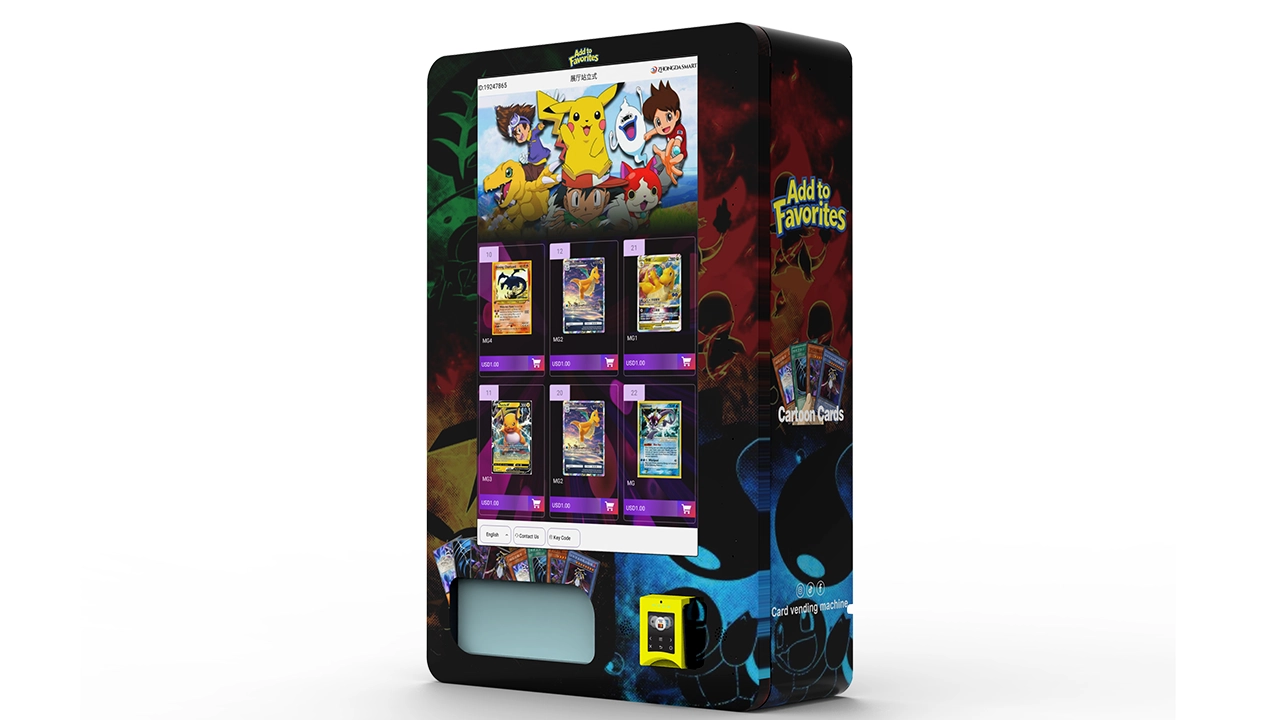
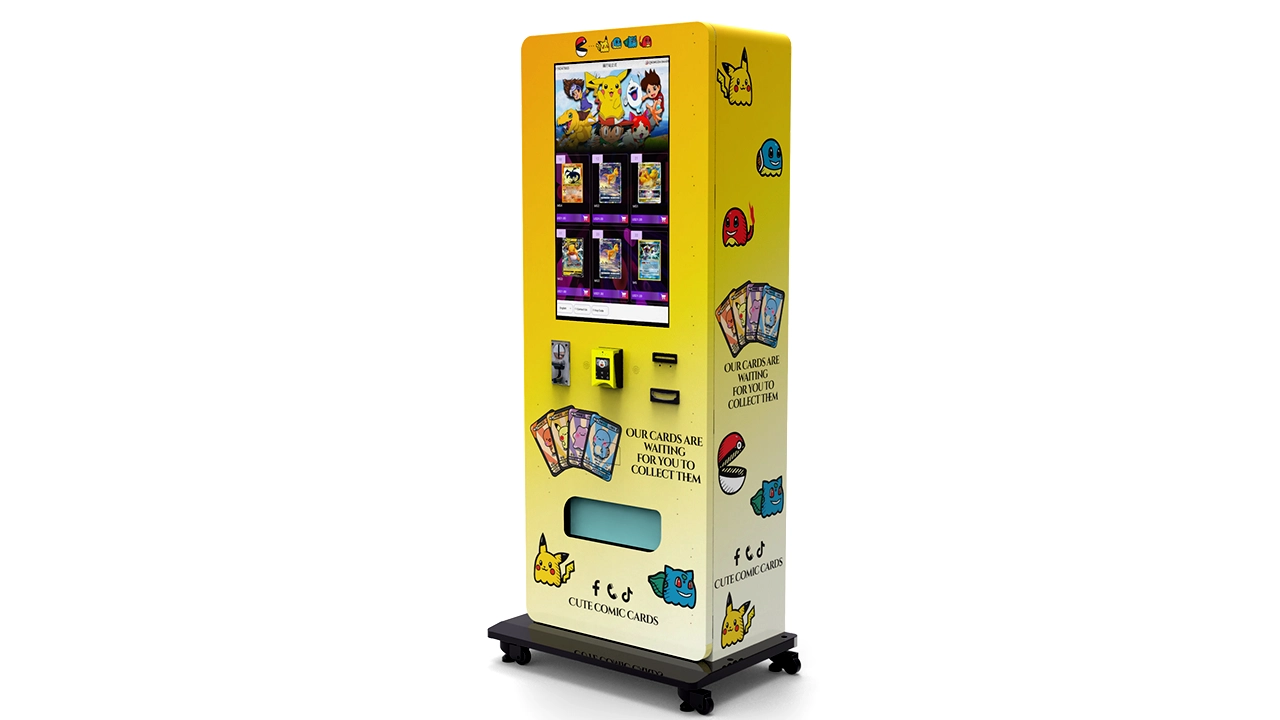
Before we get into the nuts and bolts of profitability, let me clarify what we’re talking about. A trading card vending machine is a self-service kiosk that dispenses sealed packs, boxes, or sometimes single cards from a rotating display or a gravity-fed mechanism. Unlike a standard snack machine, these units are designed specifically for card dimensions — typically around 2.5 x 3.5 inches — and they often include features like touchscreens, LED lighting, and security locks.
I’ve seen two main categories on the market. The first is the wall-mounted or countertop unit, which is compact and fits into small retail spaces, game stores, or even barbershops. The second is the full-size floor-standing kiosk, which can hold hundreds of packs and often includes a 32-inch touchscreen for browsing inventory or running promotional videos. Both have their place, and I’ll break down the cost differences later in this article.
The key thing to understand is that these machines are not just vending machines — they’re a form of automated retail that combines product display, payment processing, and inventory tracking in one unit. If you treat them like a traditional vending machine, you’ll miss out on the merchandising opportunities that make them profitable.
Is a Card Vending Machine Profitable? My Honest Answer
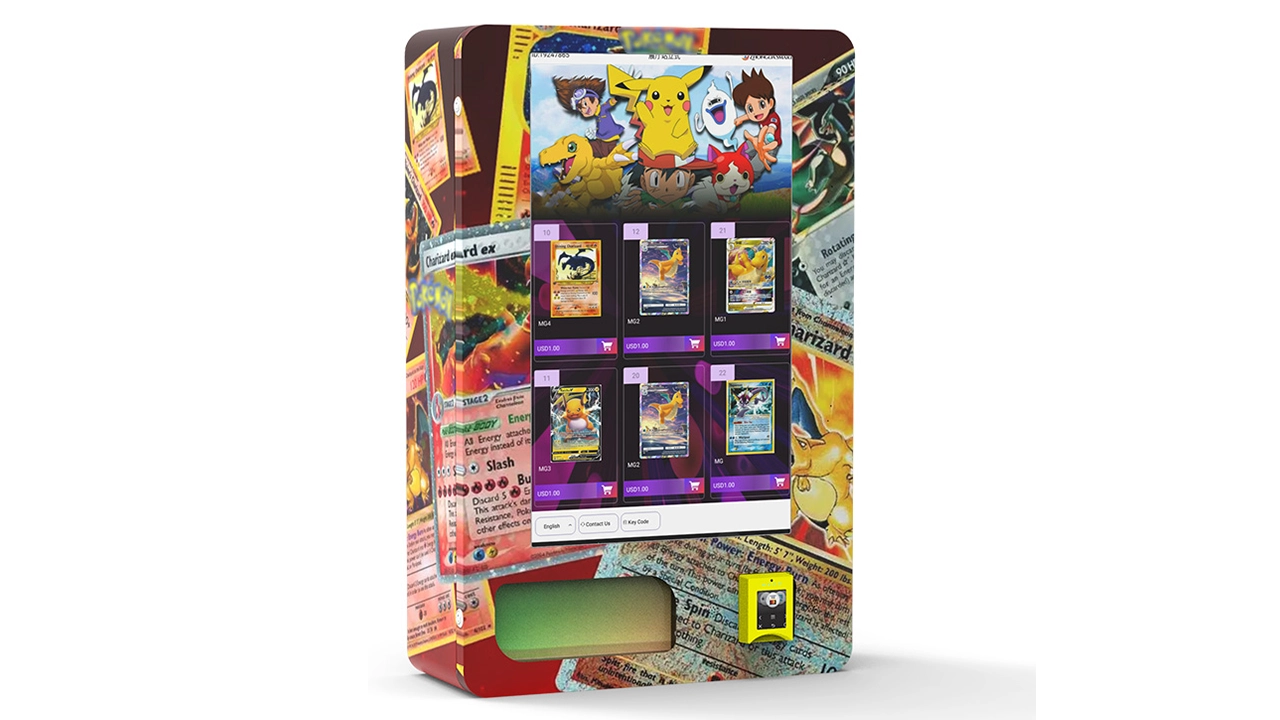
I’ve been asked this question more times than I can count, and the honest answer is: it depends entirely on your location and your product selection. In my experience, a well-placed card vending machine can generate between $1,500 and $4,000 per month in gross revenue. That’s a wide range because the variance between a high-traffic mall kiosk and a low-traffic laundromat is enormous.
Let me give you a real example. In 2019, I placed a floor-standing machine in a busy comic book convention venue that also hosted weekly trading card tournaments. That machine averaged $3,200 per month for six straight months. The margin on that revenue was roughly 55% after cost of goods and credit card processing fees. After accounting for rent (which was $200 per month) and restocking labor (about 2 hours per week), my net profit was around $1,400 per month. That’s a 14-month payback period on a $20,000 machine — not fantastic, but not bad either.
On the flip side, I placed a similar machine in a suburban gym that had decent foot traffic but zero card-buying culture. That machine did $400 in its first month and never improved. I pulled it after eight weeks. The lesson here is simple: the machine is only as good as the crowd that walks past it.
Initial Investment: How Much Does a Machine Cost?
If you’re new to this, the biggest sticker shock will be the equipment cost. A brand new full-size trading card vending machine with a touchscreen and modern payment system will run you anywhere from $15,000 to $30,000 depending on the manufacturer and configuration. Wall-mounted units are cheaper, typically in the $6,000 to $12,000 range, but they hold far less inventory and generate lower revenue per square foot.
I’ve also seen refurbished machines sell for $5,000 to $10,000, but I’d advise caution there. The card vending machine market is still young, and some older units have proprietary software that’s a nightmare to update. You might save money upfront and then spend hundreds of dollars on a technician just to change your product pricing.
One thing I always tell new operators: don’t forget the hidden costs. You’ll need a card reader (which can be integrated or added later), possibly a wireless connectivity module for remote monitoring, and a secure mounting kit if you’re placing the machine in a public area. Add another $500 to $1,500 for these extras.
Comparing Machine Types and Costs
To help you sort through the options, I’ve put together a comparison table based on what I’ve seen in the market over the past few years. These numbers are general ranges from my own experience and industry reports, not exact quotes from any single manufacturer.
| Machine Type | Typical Price Range | Inventory Capacity | Best Use Case | Estimated Monthly Revenue |
|---|---|---|---|---|
| Wall-Mounted Countertop | $6,000 – $12,000 | 50 – 100 packs | Small retail shops, barbershops, check-out areas | $500 – $1,200 |
| Mid-Size Floor Unit | $12,000 – $20,000 | 100 – 300 packs | Game stores, hobby shops, convenience stores | $1,200 – $2,500 |
| Full-Size Touchscreen Kiosk | $20,000 – $30,000 | 300 – 600 packs | Malls, entertainment venues, card shops | $2,500 – $4,500 |
That said, I’ve seen wall-mounted units outperform full-size kiosks in the right niche location. I have a client who runs a wall-mounted machine in a barbershop in a college town, and it does $900 per month consistently because the barbers talk about it with their customers and create a bit of a local buzz. The location matters more than the machine size.
Location Evaluation: The Single Biggest Factor
If there’s one piece of advice I’d tattoo on every new operator’s forehead, it’s this: evaluate the foot traffic before you even think about purchasing a machine. I’ve seen too many people buy equipment first and then scramble to find a spot for it. That’s backwards. Find the spot first, understand the people who pass through it, and then match the machine to that environment.
What I look for in a location is pretty specific. First, I want at least 500 people passing by per day. That might sound like a lot, but a busy convenience store or a mall entrance easily hits that number. Second, I want a demographic that skews younger — teens and adults in their 20s and 30s are the core trading card buyers. Third, I want a location where people have a few minutes of idle time. A laundromat, a waiting room, or a store with a long checkout line are all ideal.
I once made the mistake of placing a machine in a high-end grocery store because the foot traffic was incredible. The problem was that the average shopper was there to buy organic produce and wine, not Pokémon cards. The machine sat idle for weeks. I moved it to a local game store that had only a fraction of the foot traffic, and it doubled its revenue in the first week. The lesson stuck with me: it’s not about how many people walk by — it’s about how many of them are your target customer.
Payback Period: How Long Until You Break Even?
Let’s talk about the number everyone wants to know: how long until you get your money back. Based on my own placements and conversations with other operators, a realistic payback period for a trading card vending machine is 12 to 24 months. That assumes you’re making a net profit of $800 to $1,500 per month after all expenses.
If you’re paying $20,000 for a full-size machine and clearing $1,000 per month, that’s a 20-month payback. If you find a killer location and clear $1,800 per month, you’re looking at 11 months. The variance is huge, and it all comes down to location and product mix.
I want to be clear here: anyone who promises you a 3-month payback is selling you something. The only way you get that kind of return is if you already own a location with massive card-buying demand and you’re just adding a machine to capture existing sales. For a true small business startup, plan for a year and a half and be pleasantly surprised if you beat that.
Buy, Rent, or Lease: What’s the Smartest Move?
New operators often ask me whether they should buy a machine outright, rent one, or enter into a revenue-share agreement with a location owner. Each approach has its own set of trade-offs, and I’ve done all three at various points in my career.
Buying is the best option if you have the capital and you’re confident in your location. You own the asset, you keep all the revenue, and you can sell the machine later if you decide to exit. The downside is the upfront cost and the risk that you’ll buy a machine that doesn’t fit your needs.
Renting or leasing is attractive if you want to test the waters without a huge initial investment. Some manufacturers offer lease-to-own programs where you pay $300 to $500 per month for 24 to 36 months. The downside is that you’ll pay more in the long run, and you’re often locked into a contract even if the machine underperforms.
Revenue sharing with a location host is a middle ground. You provide the machine and the product, the host provides the space and the foot traffic, and you split the revenue 50/50 or 60/40. I’ve done this with a few game stores, and it works well when the host is actively promoting the machine to their customers. The risk is that the host loses interest, and your machine becomes a forgotten corner piece.
Comparing Operating Models
Here’s a quick breakdown of the three main operating models I’ve used or seen used by peers:
| Model | Upfront Cost | Profit Split | Control | Best For |
|---|---|---|---|---|
| Self-Owned | $15,000 – $30,000 | 100% to operator | Full control over pricing and inventory | Operators with capital and a proven location |
| Lease / Rent-to-Own | $300 – $500 / month | 100% to operator after lease payment | Moderate control; contract terms apply | New operators testing the market |
| Revenue Share with Host | $0 – $5,000 (machine deposit) | 50/50 or 60/40 split | Shared decision-making with host | Operators with strong host partnerships |
My personal preference for new operators is the self-owned model, but only if you’ve secured a location first. If you’re truly unsure about the business, a short-term lease gives you an exit strategy without losing your entire investment.
How to Choose a Supplier: What I Look For
I’ve bought machines from five different manufacturers over the years, and I’ve learned that the supplier is just as important as the machine itself. You want a manufacturer that doesn’t just sell you a box and disappear. You want someone who offers technical support, spare parts, and software updates.
One supplier that has impressed me recently is Zhongda Smart. They’re a Chinese manufacturer that has expanded into the trading card vending machine market, and what I appreciate about them is that they actually understand the card format. Their machines have adjustable shelves that can handle different pack sizes, and their software allows you to set dynamic pricing based on demand. I’ve also found their after-sales support to be responsive, which is rare in this industry.
That said, I always recommend that buyers look for three things in any supplier. First, ask for a list of existing installations and try to contact a few operators. Second, demand a demo or a video showing the machine dispensing cards properly — not just a rendering. Third, check the warranty terms. A standard warranty should cover at least one year on parts and labor, and you should be able to buy an extended service plan.
Common Mistakes I’ve Made (and Seen Others Make)
Let me be honest with you: I’ve made plenty of mistakes in this business, and I’d rather share them so you don’t repeat them. The first big mistake I made was underestimating the importance of product rotation. I stocked a machine with the same Pokémon sets for three months, and sales dropped steadily because regular customers had already bought what they wanted. Once I started rotating in new sets every two weeks, sales jumped back up.
The second mistake was ignoring the payment system. Early card vending machines only accepted coins and bills, which limited sales to people carrying cash. I lost countless sales because younger customers only had debit cards or mobile wallets. Modern machines need to accept credit cards, Apple Pay, and Google Pay. I now refuse to install any machine that doesn’t have a modern payment terminal.
Another common mistake is poor placement within a location. Just because a store has good foot traffic doesn’t mean every corner is a good spot. I’ve seen machines tucked behind a pillar or next to a noisy video game cabinet, where nobody could see them. The machine needs to be visible from the entrance and placed near high-traffic paths. If the store owner insists on putting it in a back corner, walk away.
A Failure Case That Taught Me About Location
I mentioned earlier that I placed a machine in a suburban gym and it failed. Let me give you the full story because it illustrates a key point. The gym had about 800 members and a steady stream of visitors throughout the day. The owner was enthusiastic and even offered to promote the machine on their social media. I thought it was a slam dunk.
What I didn’t account for was the psychology of the gym crowd. People who go to the gym are usually there to work out, not to browse merchandise. They’re focused, they’re sweaty, and they want to leave quickly. The few people who did stop to look at the machine were curious, but they weren’t card collectors. After two months of disappointing revenue, I moved the machine to a nearby hobby store, where it now does three times the revenue. The gym location wasn’t bad because of foot traffic — it was bad because the audience was wrong.
A Success Case That Reinforced My Strategy
On the positive side, I had a success story that confirmed everything I believe about this business. A local card shop owner approached me about placing a machine in his store. He had a loyal customer base that came in for weekly tournaments, and he wanted a way to sell packs after hours and during events when he was busy at the register.
We installed a mid-size floor unit with a 32-inch touchscreen, and I worked with him to stock a mix of Pokémon, sports cards, and mystery packs. The machine did exceptionally well because it wasn’t just a vending machine — it was an extension of his store’s product line. Customers would line up to use it during tournament breaks. That machine paid for itself in nine months, and the store owner has since ordered two more for his other locations.
Maintenance and Repair: What You Need to Know
Let’s talk about the less glamorous side of this business: maintenance. Trading card vending machines are relatively simple devices, but they do break down. The most common issues I’ve encountered are jammed dispensers, faulty card readers, and software glitches that cause the machine to go offline.
I recommend budgeting about $50 to $100 per month for routine maintenance. This covers things like cleaning the sensors, checking the card dispenser mechanism, and updating the software. For more serious repairs, you’ll want a local vending machine repair technician who can work on the unit. I’ve found that most standard vending repair companies can handle card machines if they have basic electrical and mechanical skills, but you should confirm this before you purchase.
One thing that saves me a lot of headaches is buying machines with remote monitoring capabilities. Many modern units have a cellular or Wi-Fi connection that sends you real-time alerts about inventory levels and technical issues. This lets you address problems before they become major failures. It’s an extra cost, but it’s worth every penny.
Restocking and Inventory Management
Restocking a card vending machine is not like restocking a snack machine. You’re dealing with small, high-value items that are prone to theft and counterfeiting. I always recommend that operators keep their card inventory locked in a secure storage area and only carry enough stock for the next few days of sales.
My restocking routine is simple. I visit each machine every 7 to 10 days, check the inventory levels through the remote monitoring system, and bring exactly what I need. This minimizes the amount of time I spend at each location and reduces the risk of stock being stolen during transit.
I also track sales data carefully to identify trends. For example, I’ve noticed that new set releases cause a spike in sales for about two weeks, followed by a decline. I use that data to plan my purchasing and avoid overstocking products that have lost their appeal.
Payment Systems and the Unattended Retail Experience
Modern card vending machines are essentially unattended retail kiosks, which means the payment experience needs to be seamless. I’ve seen machines that only accept coins, and they’re a relic of the past. Today’s customers expect to pay with a tap of their phone or a quick card swipe.
When you’re choosing a machine, make sure it has a payment system that supports major credit cards, debit cards, and mobile wallets. Some machines also support cash, which is still important in certain areas. I’ve found that machines with a touchscreen interface that lets customers browse the available products before purchasing have higher conversion rates because it creates a more engaging experience.
One thing to watch out for is the processing fees on card payments. Depending on your payment processor, you could be paying 2.5% to 3.5% per transaction. That eats into your margin, so you need to factor it into your pricing. I typically add a small premium to card purchases or build the fee into the pack price.
Legal Considerations and Permits
Depending on where you operate, you may need a business license, a vending permit, or even a specific license for selling trading cards. In the United States, most states require a general business license, and some cities require a separate vending machine permit. In the European Union, the rules vary by country, but you generally need to register your business and comply with local tax regulations.
I’d advise you to check with your local chamber of commerce or small business administration office before you install your first machine. The U.S. Small Business Administration has resources that can help you understand the licensing requirements in your area. It’s not glamorous work, but it’s essential.
One more thing: make sure you’re not selling counterfeit cards. The trading card market has a serious problem with fakes, and if you’re caught selling counterfeit product, you could face legal action and damage your reputation. Buy only from authorized distributors or reputable wholesalers.
Data, Market Trends, and What the Numbers Say
If you’re looking for broader market data, the vending machine industry has been growing steadily. According to Statista, the global vending machine market was valued at around $32 billion in 2023 and is projected to grow at a compound annual growth rate of about 6% through 2030. The trading card segment is a small but fast-growing niche within that market, driven by the resurgence of Pokémon and sports card collecting.
IBISWorld reports that the vending machine operation industry in the U.S. generates about $8 billion in annual revenue, with an average profit margin of around 6% to 8% for traditional operators. Card vending machines can achieve much higher margins because of the low cost of goods and the passionate consumer base, but they also carry higher risk if you choose the wrong location.
I’ve also seen data from the European Automated Vending Association suggesting that unattended retail is growing faster than traditional vending in several European markets, particularly in the UK, France, and Germany. This aligns with what I’ve observed on the ground: consumers are increasingly comfortable buying from self-service kiosks, especially when they’re familiar with the product category.
Is This Business Right for You?
At the end of the day, trading card vending machines are a viable small business opportunity, but they’re not a get-rich-quick scheme. They require careful planning, a good location, and a willingness to stay on top of inventory and maintenance. If you’re willing to put in the work, the returns can be solid.
I’ve seen independent operators turn a single machine into a small fleet of ten or more, generating six figures in annual revenue. I’ve also seen people give up after six months because they didn’t do their homework. The difference is almost always the same: the successful operators treated it like a real business, not a passive income stream.
If you’re ready to move forward, my advice is to start small. Find a location with the right demographic, buy a machine that fits that space, and track your results carefully. Learn from the data, adjust your product mix, and expand only when you have proof that the model works.
And as with any business, there are risks. Market demand for trading cards can fluctuate with trends, and a machine that’s profitable today might not be next year. That’s why it’s important to stay flexible and be willing to move your machine to a better location if needed.
I’ll leave you with this: the best trading card vending machines for small businesses are the ones that are placed thoughtfully, stocked intelligently, and maintained consistently. The machine is just a tool — your business acumen is what makes it profitable.
Frequently Asked Questions
Are trading card vending machines profitable?
Yes, they can be profitable if placed in a location with the right demographic and foot traffic. Based on my experience, a well-placed machine can generate $1,500 to $4,000 per month in gross revenue with a net profit margin of 40% to 55% after product costs, rent, and maintenance. However, profitability depends heavily on location, product selection, and how often you restock.
How much does a trading card vending machine cost?
Prices vary by size and features. Wall-mounted units typically cost between $6,000 and $12,000, mid-size floor units run $12,000 to $20,000, and full-size touchscreen kiosks can cost $20,000 to $30,000 or more. You’ll also need to budget for payment systems, installation, and initial inventory.
How long does it take to make your money back?
Most operators I know see a payback period of 12 to 24 months. If you secure a high-traffic location with strong card-buying demand, you might break even in as little as 9 to 12 months. If the location is marginal, it could take longer or never pay back, which is why location scouting is so important.
Should a beginner buy or lease a machine?
If you’re new and unsure about the business, leasing or a rent-to-own arrangement is a lower-risk option. You’ll pay $300 to $500 per month, but you can exit if the machine underperforms. If you’ve already secured a promising location and have the capital, buying outright is better in the long run because you keep all the profits.
Where is the best place to put a card vending machine?
Look for locations with at least 500 passersby per day, a younger demographic, and a culture of collecting or gaming. Card shops, hobby stores, game stores, malls, and entertainment venues are ideal. Avoid locations where the audience is predominantly older or not interested in collectibles, even if foot traffic is high.
What permits or licenses do I need?
Requirements vary by city and country. In the U.S., you typically need a general business license, and some cities require a vending machine permit. In the EU, you’ll need to register your business and comply with local tax rules. Check with your local small business administration or chamber of commerce for specifics.
How do I choose a reliable supplier?
Look for a supplier with a track record in card vending machines, responsive after-sales support, and a warranty of at least one year. Ask for references from existing operators and request a demo video. Manufacturers like Zhongda Smart are worth considering because they specialize in this niche and offer good support.
What happens if the machine breaks down?
Most common issues are jammed dispensers, faulty card readers, or software glitches. Budget $50 to $100 per month for routine maintenance and have a local vending repair technician on call. Machines with remote monitoring can alert you to issues before they become major problems.
How can I reduce restocking and maintenance costs?
Use a machine with remote inventory monitoring so you only visit when restocking is needed. Plan your restocking routes efficiently and track sales data to avoid overstocking slow-moving products. Buying higher-quality machines upfront also reduces repair frequency and downtime.